


Page 161 - Separation process principles 2
P. 161
126  Chapter 4  Single Equilibrium Stages and Flash Calculations


                      In extractive distillation, as discussed in Chapter 1, a sol-   Typically, the vapor phase is sent to a vapor separation sys-
                   vent is added, usually near the top of the column, to selec-   tem, while the liquid phase is sent to a liquid separation sys-
                   tively alter the activity coefficients in order to increase the   tem. Computational methods for a single-stage flash calcula-
                   relative volatility between the two species to be separated.   tion are of  fundamental importance. Such calculations are
                   The  solvent  is  generally  a  relatively  polar,  high-boiling   used not only for the operations in Figure 4.10, but also to
                   constituent, such as phenol, aniline, or furfural, which con-   determine, anywhere in a process, the phase condition of a
                   centrates at the bottom of the column.              stream or batch  of  known composition, temperature,  and
                                                                       pressure.
                                                                         For the single-stage equilibrium operation with one feed
                   4.4  MULTICOMPONENT FLASH,
                                                                       stream and two product streams, shown in Figure 4.10, the
                   BUBBLE-POINT, AND DEW-POINT
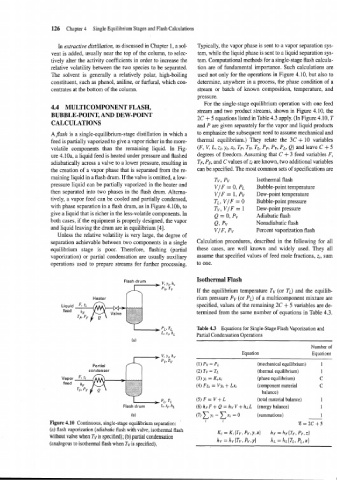
                                                                       2C + 5 equations listed in Table 4.3 apply. (In Figure 4.10, T
                   CALCULATIONS
                                                                       and P are given separately for the vapor and liquid products
                   AJEash is a single-equilibrium-stage distillation in which a   to emphasize the subsequent need to assume mechanical and
                   feed is partially vaporized to give a vapor richer in the more-   thermal  equilibrium.) They  relate  the  3C + 10  variables
                   volatile  components  than  the  remaining  liquid.  In  Fig-   (F, V, L, z,, Yi, xi, TF, Tv, TL, PF, Pv, PL, Q) and leave C + 5
                   ure 4.10a, a liquid feed is heated under pressure and flashed   degrees of freedom. Assuming that C + 3 feed variables F,
                   adiabatically across a valve to a lower pressure, resulting in   TF, PF, and C values of zi are known, two additional variables
                   the creation of a vapor phase that is separated from the re-   can be specified. The most common sets of specifications are
                   maining liquid in a flashhrum. If the vive is omitted, a low-
                                                                                            Isothermal flash
                   pressure liquid can be partially vaporized in the heater and
                                                                                            Bubble-point temperature
                   then separated into two phases in the flash drum. Alterna-
                                                                                            Dew-point temperat~~re
                   tively, a vapor feed can be cooled and partially condensed,
                                                                                            Bubble-point pressure
                   with phase separation in a flash drum, as in Figure 4.10b, to
                                                                                            Dew-point pressure
                   give a liquid that is richer in the less-volatile components. In
                                                                                            Adiabatic flash
                   both cases, if the equipment is properly designed, the vapor               on adiabatic flash
                   and liquid leaving the drum are in equilibrium [4].
                                                                                            Percent vaporization flash
                      Unless the relative volatility is very large, the degree of
                   separation achievable between two components in a single   Calculation procedures, described in  the following for all
                   equilibrium  stage  is  poor.  Therefore,  flashing  (partial   these  cases,  are  well  known  and  widely  used.  They  all
                   vaporization) or partial condensation are usually  auxiliary   assume that specified values of feed mole fractions, zi, sum
                   operations used to  prepare streams for further processing.   to one.


                                             Flash drum                  so thermal Flash
                                                          V, Y,.  h,
                                                          Pv, Tv       If the equilibrium temperature Tv (or TL) and the equilib-
                                  Heater                               rium pressure Pv (or PL) of a multicomponent mixture are
                                                                       specified, values of the remaining 2C + 5 variables are de-
                                                                       termined from the same number of equations in Table 4.3.


                                                                       Table 4.3  Equations for Single-Stage Flash Vaporization and
                                                                      Partial Condensation Operations
                                                                                                               Number of
                                                                                      Equation                 Equations
                                                          v. Y;, hv
                                              A-*
                                  Partial                 pVr TV      (l)Pv= PL             (mechanical equilibrium)   1
                                 condenser    1    1                  (2) Tv = TL           (thermal equilibrium)   1
                                                                      (3) ~i  = Kix,        (phase equilibrium)   C
                                                                      (4) Fzi  = Vy, + Lx;   (component material   C
                                                                                             balance)
                                                                                                                  1
                                                                      (5)F=VtL
                                                I>
                                                                                            (total material balance)
                                                          PL.
                                                            TL
                                             Flash drum   L. xi, hL   (6)hFF+Q=hvV+hLL  (energybalance)           1
                                                                      (7)C~i -Cxi  =O       (summations)          1
                   Figure 4.10  Continuous, single-stage equilibrium separation:   I   i                  %=2C+5
                   (a) flash vaporization (adiabatic flash with valve, isothermal flash
                                                                              Ki  = Ki{Tv, PV,Y? x)   h~ = ~FITF, PF, Z]
                   without valve when Tv is specified); (b) partial condensation
                                                                              hv = ~vP'v, Pv,rI    = ~L~TL, PL,xl
                   (analogous to isothermal flash when TV is specified).

