


Page 156 - Separation process principles 2
P. 156
4.2  Binary Vapor-Liquid  Systems  121


          Mole fraction of methanol in liquid, x,  or vapor, y   Mole fraction of methanol in liquid
                          (a)                                    (b)


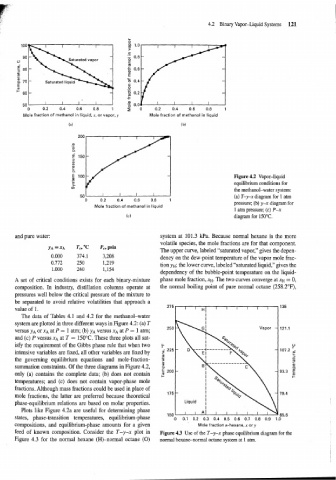
                                                                                    Figure 4.2  Vapor-liquid
                                                                                    equilibrium conditions for
                                                                                    the methanol-water  system:
                              501     I     I     I    I                            (a) T-y-x  diagram for 1 atm
                               0     0.2   0.4   0.6   0.8   1
                                                                                    pressure; (b) y-x  diagram for
                                   Mole fraction of methanol in liquid
                                                                                    1 atrn pressure; (c) P-x
                                              (c)                                   diagram for 150°C.


       and pure water:                                    system at  101.3 kPa. Because normal  hexane is the more
                                                          volatile species, the mole fractions are for that component.
                  y~ =XA    Tc, OC   PC, psia
                                                          The upper curve, labeled "saturated vapor," gives the depen-
                   0.000     374.1    3,208               dency on the dew-point temperature of the vapor mole frac-
                   0.772     250      1,219
                                                          tion y~; lower curve, labeled "saturated liquid," gives the
                                                                the
                    1  .OOO   240     1,154
                                                          dependency of the bubble-point temperature on the liquid-
       A set of  critical conditions exists for each binary-mixture   phase mole fraction, XH. The two curves converge at XH = 0,
       composition.  In  industry,  distillation  columns  operate  at   the normal boiling point of pure normal octane (258.2"F),
       pressures well below the critical pressure of the mixture to
       be  separated to  avoid relative volatilities that  approach a
                                                            275    I   I                            135
       value of 1.
                                                                         "  1  "  1  1  1  1
         The data of Tables 4.1 and 4.2 for the methanol-water            I
       system are plotted in three different ways in Figure 4.2: (a) T
                                                                                             Vapor  - 121.1
       versus y~ or XA at P = 1 atm; (b) y~ versus XA at P = 1 atm;
       and (c) P versus XA at T = 150°C. These three plots all sat-
       isfy the requirement of the Gibbs phase rule that when two   +
       intensive variables are fixed, all other variables are fixed by
       the  governing  equilibrium  equations  and  mole-fraction-
       summation constraints. Of the three diagrams in Figure 4.2,
       only  (a) contains the complete data;  (b) does not  contain
       temperatures; and  (c) does not  contain  vapor-phase mole
       fractions. Although mass fractions could be used in place of   175 -
       mole fractions, the latter are preferred because theoretical
       phase-equilibrium relations are based  on molar properties.
         Plots like Figure 4.2a are useful for determining phase
       states,  phase-transition  temperatures,  equilibrium-phase   o   0.1  0.2  0.3  0.4  0.5  0.6  0.7  0.8  0.9  1.0
       ~orn~oshions, and  equilibrium-phase amounts for a given        Mole fraction n-hexane, x or y
       feed of  known composition. Consider the  T-Y-x  plot  in   Figure 4.3  Use of  the T-y-x  phase equilibrium diagram for the
       Figure 4.3 for the  normal  hexane  (H)-normal  octane  (0)  normal hexane-normal  octane system at 1 atm.

