


Page 153 - Separation process principles 2
P. 153
118  Chapter 4  Single Equilibrium Stages and Flash Calculations

                     Regardless of  whether  only intensive variables or both
                  intensive and extensive variables are considered, only a few
                  of the variables are independent; when these are specified,
                  all other variables become fixed. The number of independent
                  variables is referred to  as the  variance  or the  number  of
                  degrees of  freedom, F, for the system.
                                                                                                                   L
                     The phase rule of J. Willard Gibbs, which applies only to
                  the intensive variables at equilibrium, is used to determine F.  lndependent equations:   lndependent equations:
                                                                                                    Same as for (a) plus
                  The rule states that
                                                                                                    Fz,=Vy,+Lx,   i=ItoC
                                                                                                    FhF + Q = Vh, + Lh,
                  where C is the number of components and 9 is the number
                  of phases at equilibrium. Equation (4-1) is derived by count-
                  ing, at physical equilibrium, the number of intensive vari-
                  ables and the number of  independent equations that relate
                  these variables. The number of intensive variables, "V, is
                                                                             (a)                          (b)
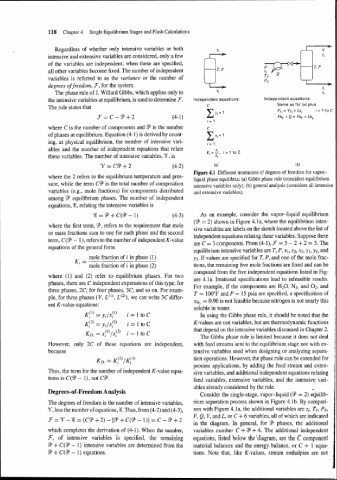
                                                                      Figure 4.1  Different treatments of  degrees of freedom for vapor-
                  where the 2 refers to the equilibrium temperature and pres-
                                                                      liquid phase equilibria: (a) Gibbs phase rule (considers equilibrium
                  sure, while the term C9 is the total number of composition   intensive variables only); (b) general analysis (considers all intensive
                  variables (e.g., mole fractions) for components distributed   and extensive variables).
                  among 9 equilibrium phases. The number of  independent
                  equations, %, relating the intensive variables is
                                                                        As  an  example, consider the  vapor-liquid  equilibrium
                                                                      (9  = 2) shown in Figure 4.la, where the equilibrium inten-
                  where the first term, 9, refers to the requirement that mole
                                                                      sive variables are labels on the sketch located above the list of
                  or mass fractions sum to one for each phase and the second   independent equations relating these variables. Suppose there
                  term, C(9 - 1), refers to the number of independent K-value
                                                                      are C = 3 components. From (4-l), F = 3 - 2 + 2 = 3. The
                  equations of the general form
                                                                      equilibrium intensive variables are T, P, XI, x2, x3, yl, y2, and
                                 mole fraction of i in phase (1)      y3. If values are specified for T, P, and one of the mole frac-
                            Ki =
                                 mole fraction of i in phase (2)      tions, the remaining five mole fractions are fixed and can be
                                                                      computed from the five independent equations listed in Fig-
                  where  (1)  and  (2)  refer  to  equilibrium  phases.  For  two                                       '
                                                                      ure 4.la. Irrational specifications lead to infeasible results.
                  phases, there are C independent expressions of this type; for
                                                                      For example, if  the components are H20, Nz, and 02, and
                  three phases, 2C; for four phases, 3C; and so on. For exam-                                           i
                                                                      T = 100°F and P = 15 psia are specified, a specification of
                  ple, for three phases (V, L('), L(')), we can write 3C differ-                                        i
                                                                      XN~ = 0.90 is not feasible because nitrogen is not nearly this   3
                  ent K-value equations:
                                                                      soluble in water.                                 j
                                 (1)
                               K,  =yi/x!')   i=ltoC                    In using the Gibbs phase rule, it should be noted that the
                               K,  = yi/~12)  i = 1 to c              K-values are not variables, but are thermodynamic functions
                                 (2)
                                       1)  (2)  i=ltoC
                                KD, = xi  /xi                         that depend on the intensive variables discussed in Chapter 2.
                                                                        The Gibbs phase rule is limited because it does not deal
                  However,  only  2C  of  these  equations  are  independent,   with feed streams sent to the equilibrium stage nor with ex-
                  because                                             tensive variables used when designing or analyzing separa-
                                           (2)
                                    KD, = Ki  /Ki  (1)                tion operations. However, the phase rule can be extended for
                                                                      process applications, by adding the feed stream and exten-
                  Thus, the term for the number of independent K-value equa-   sive variables, and additional independent equations relating
                  tions is C(9 - l), not C9.                          feed variables, extensive variables, and the intensive vari-
                                                                      ables already considered by the rule.
                  Degrees-of-Freedom Analysis
                                                                        Consider the single-stage, vapor-liquid  (9  = 2) eciuilib-
                  The degrees of freedom is the number of intensive variables,   rium separation process shown in Figure 4. lb. By compari-
                  "V, less the number of equations, 5%. Thus, from (4-2) and (4-3),   son with Figure 4.la, the additional variables are zi, TF, PF,
                                                                      F, Q, V,  and L, or C + 6 variables, all of which are indicated
                                                                      in  the  diagram.  In  general, for  9 phases,  the  additional
                  which completes the derivation of (4-1). When the number,   variables number C + 9 + 4. The  additional independent
                  .?,  of  intensive  variables  is  specified,  the  remaining   equations, listed below  the 'diagram, are the C component
                  9 + C(9 - 1) intensive variables are determined from the   material balances and  the energy balance, or C + 1 equa-
                  9 + C(9 - 1) equations.                             tions. Note  that,  like K-values,  stream enthalpies are  not

