


Page 157 - Separation process principles 2
P. 157
122  Chapter 4  Single Equilibrium Stages and Flash Calculations


                  and at XH  = I, the normal boiling point of  normal hexane
                  (155.7"F). In order for two phases to exist, a point represent-
                 ing the overall composition of the two-phase binary mixture
                  at a  given  temperature must be  located  in  the  two-phase
                 region between the two curves. If  the point lies above the
                  saturated-vapor curve, only a superheated vapor is present;
                 if the point lies below the saturated-liquid curve, only a sub-
                 cooled liquid exists.
                    Suppose we have a mixture of 30 mol% H at 150°F. From
                 Figure  4.3,  at point  A  we  have  a  subcooled  liquid  with
                 XH  = 0.3(x0 = 0.7). When this mixture is heated at a con-
                  stant pressure of  1 atm, the liquid state is maintained until a   I  I  I  I  I  I  I  I  I
                 temperature of 210°F is reached, which corresponds to point B   0  0.1 0.2 0.3 0.4 0.5 0.6 0.7 0.8 0.9 1.0
                 on the saturated-liquid curve. Point B is the bubble point        Mole Fraction n-hexane in liquid, x
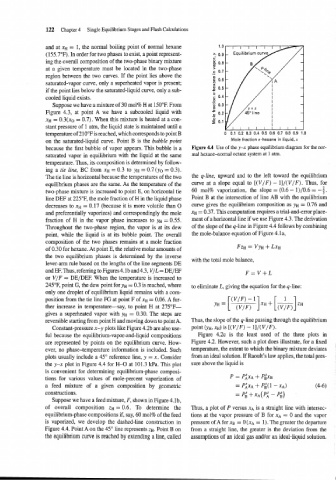
                 because the first bubble of  vapor appears. This bubble is a   Figure 4.4  Use of the y-x  phase equilibrium diagram for the nor-
                  saturated vapor in  equilibrium with the liquid at the same   mal hexane-normal octane system at 1 atm.
                 temperature. Thus, its composition is determined by follow-
                  ing  a tie  line,  BC  from XH  = 0.3 to y~ = 0.7 (yo = 0.3).
                 The tie line is horizontal because the temperalures of the two   the  q-line,  upward  and  to  the left  toward the equilibrium
                 equilibrium phases are the same. As the temperature of  the   curve at  a  slope equal to  [(V/ F) - l]/(V/ F). Thus, for
                 two-phase mixture is increased to point E, on horizontal tie   60  mol%  vaporization, the  slope = (0.6 - 1)/0.6 = -;.
                 line DEF at 225"F, the mole fraction of H in the liquid phase   Point B at the intersection of  line AB with the equilibrium
                 decreases to XH  = 0.17 (because it is more volatile than 0   curve gives the equilibrium composition as y~ = 0.76 and
                 and preferentially vaporizes) and correspondingly the mole   XH = 0.37. This computation requires a trial-and-error place-
                 fraction of  H  in  the  vapor phase  increases  to  y~ = 0.55.   ment of a horizontal line if we use Figure 4.3. The derivation
                 Throughout the two-phase region,  the  vapor is  at its dew   of the slope of the q-line in Figure 4.4 follows by combining
                 point,  while  the  liquid is  at its bubble point. The overall   the mole-balance equation of Figure 4.la,
                 composition of  the two pl~ases remains at a mole fraction
                 of 0.30 for hexane. At point E, the relative molar amounts of
                 the  two  equilibrium phases  is  determined by  the  inverse
                                                                     with the total mole balance,
                 lever-arm rule based on the lengths of the line segments DE
                 and EF. Thus, referring to Figures 4.  lb and 4.3, V/L = DE/EF
                 or V/F  = DE/DEF. When the temperature is increased to
                 245"F, point G, the dew point for y~ = 0.3 is reached, where   to eliminate L, giving the equation for the q-line:
                 only one droplet of equilibrium liquid remains with a com-
                 position from the tie line FG at point F of x~ = 0.06. A fur-
                 ther  increase in  temperature-say,  to  point  H at 275°F-
                 gives a  superheated vapor  with y~ = 0.30. The steps are
                 reversible starting from point H and moving down to point A.   Thus, the slope of the q-line passing through the equilibrium
                    Constant-pressure x-y  plots like Figure 4.2b are also use-   point CYH, XH) is [( VIF) - I]/( VIF).
                 ful because the equilibrium-vapor-and-liquid compositions   Figure  4.2~ is  the  least  used  of  the  three  plots  in
                 are represented by  points  on  the equilibrium curve. How-   Figure 4.2. However, such a plot does illustrate, for a fixed
                 ever,  no  phase-temperature  information is  included.  Such   temperature, the extent to which the binary mixture deviates
                 plots usually include a 45" reference line, y = x. Consider   from an ideal solution. If Raoult's law applies, the total pres-
                 the y-x  plot in Figure 4.4 for H-0  at 101.3 kPa. This plot   sure above the liquid is
                 is convenient for determining equilibrium-phase composi-
                 tions  for  various  values  of  mole-percent  vaporization  of
                 a  feed  mixture  of  a  given  composition  by  geometric
                 constructions.
                    Suppose we have a feed mixture, F, shown in Figure 4. lb,
                 of  overall  composition  ZH = 0.6.  To  determine  the   Thus, a plot of P versus XA is a straight line with intersec-
                 equilibrium-phase compositions if, say, 60 mol% of the feed   tions at the vapor pressure of  B for XA  = 0 and the vapor
                 is  vaporized, we  develop the  dashed-line construction in   pressure of A for x~ = 0 (xA = 1). The greater the departure
                 Figure 4.4. Point A on the 45" line represents ZH. Point B on   from a straight line, the  greater is  the  deviation from the
                 the equilibrium curve is reached by extending a line, called   assumptions of an ideal gas andlor an ideal-liquid solution.

