


Page 160 - Separation process principles 2
P. 160
4.3  Azeotropic Systems  125


                  Mole fraction water                      Mole fraction water
                  in liquid phase, xl                       in liquid phase, xl


                                              Vapor    -
                               120 -
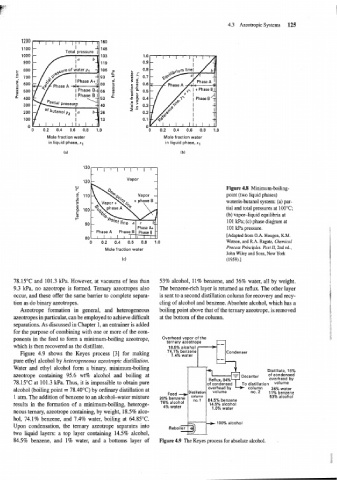
                                                        -                        Figure 4.8  Minimum-boiling-
                                                                                 point (two liquid phases)
                                                                                 waterln-butanol system: (a) par-
                                                                                 tial and total pressures at 100°C;
                                                                                 (b) vapor-liquid  equilibria at
                                                                                 101 kPa; (c) phase diagram at
                                                  Phase At  -                    101 kPa pressure.
                                 -  Phase A   Phase B  Phase B
                                                                                 [Adapted from O.A. Hougen, K.M.
                               80   1  1  1  1  1  1  1  1  1  -
                                 0   0.2   0.4   0.6   0.8   1.0                 Watson, and R.A. Ragatz, Chemical
                                                                                 Process Principles. Part II, 2nd ed.,
                                      Mole fraction water
                                                                                 John Wiley and Sons, New York
                                            (c)                                  (1959).]


      78.15"C and 101.3 kPa. However, at vacuums of  less than   53% alcohol,  11% benzene, and 36% water, all by weight.
      9.3 kPa, no azeotrope is formed. Ternary azeotropes also   The benzene-rich layer is returned as reflux. The other layer
      occur, and these offer the same barrier to complete separa-   is sent to a second distillation column for recovery and recy-
      tion as do binary azeotropes.                      cling of alcohol and benzene. Absolute alcohol, which has a
        Azeotrope  formation  in  general,  and  heterogeneous   boiling point above that of the ternary azeotrope, is removed
      azeotropes in particular, can be employed to achieve difficult   at the bottom of the column.
      separations. As discussed in Chapter 1, an entrainer is added
      for the purpose of combining with one or more of the com-
      ponents in the feed to form a minimum-boiling azeotrope,   Overhead vapor of the
                                                            ternary azeotrope
      which is then recovered as the distillate.             18.5% alcohol
        Figure  4.9  shows  the  Keyes  process  [3]  for  making   74.1% benzene
                                                              7.4% water
      pure ethyl alcohol by heterogeneous azeotropic distillation.
      Water  and  ethyl  alcohol form a binary, minimum-boiling
                                                                                                Distillate,  16%
      azeotrope  containing  95.6  wt%  alcohol  and  boiling  at                     Decanter   of condensed
                                                                                                overhead by
      78.15"C at 101.3 kPa. Thus, it is impossible to obtain pure                     To distillation
      alcohol (boiling point = 78.40°C) by ordinary distillation at        overhead by  L) column   36% water
                                                                                          no. 2   11% benzene
      1 atm. The addition of benzene to an alcohol-water  mixture                               53% alcohol
      results  in  the  formation of  a minimum-boiling, heteroge-
                                                           4% water        14.5% alcohol
                                                                            1.0% water
      neous ternary, azeotrope containing, by weight, 18.5% alco-
      hol,  74.1% benzene, and 7.4% water, boiling at 64.85OC.
                                                                              100% alcohol
      Upon  condensation,  the  ternary  azeotrope  separates  into
      two  liquid  layers:  a  top  layer  containing  14.5% alcohol,
      84.5%  benzene,  and  1%  water,  and  a  bottoms  layer  of   Figure 4.9  The Keyes process for absolute alcohol.

