


Page 164 - Separation process principles 2
P. 164
4.4  Multicomponent Flash; Bubble-Point, and Dew-Point Calculations  129


                                                          SOLUTZON

       In Figure 1.9, the nC4-rich bottoms product from column C3 has   Because the  bubble-point pressure is likely to  be below  ambi-
       the composition given in Table 1.5. If the pressure at the bottom of   ent  pressure,  the  modified  Raoult's  law  in  the  form  of  (4-16)
       the distillation column is 100 psia (689 Ha), estimate the tempera-   applies for either liquid phase. If the methanol-rich layer data are
       ture of the mixture.                               used:

                                                              Pbubble = 1.118(0.7615)(2.45) $4.773(0.1499)(1.89)
       SOLUTZON                                                       + 3.467(0.0886)(6.14)
                                                                    = 5.32 psia (36.7 Ha)
       The bottoms product will be a liquid at its bubble point with the
       following composition:
                                                          A similar calculation based on the cyclohexane-rich layer gives an
                                                          identical result because the data are consistent with phase equilib-
              Component       kmol/h       zi = xi
                                                          rium theory such that y/L)x/l) = y/Z)~/2). A pressure higher than
               i-Butane         8.60      0.03 19         5.32 psia will prevent formation of vapor at this location in the ex-
               n-Butane       215.80      0.7992          traction process. Thus, operation at atmospheric pressure is a good
               i-Pentane       28.10      0.1041          choice.
               n-Pentane       17.50      0.0648
                              270.00       1  .OOOO

       The bubble-point temperature can be estimated by finding the tem-   EXAMPLE 4.4
       perature that will satisfy (4-12), using K-values from Figure 2.8.
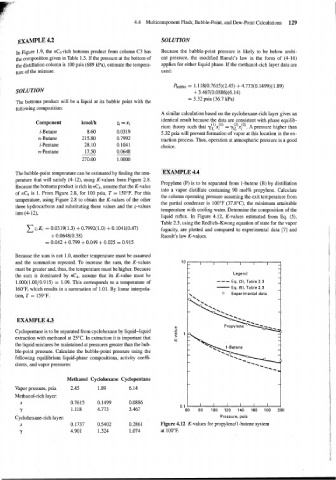
                                                          Propylene (P) is to be separated from 1-butene (B) by  distillation
       Because the bottoms product is rich in nC4, assume that the K-value
                                                          into a  vapor  distillate containing  90 mol% propylene.  Calculate
       of nC4 is  1. From Figure 2.8, for  100 psia, T = 150°F. For this
                                                          the column operating pressure assuming the exit temperature from
       temperature, using Figure 2.8 to obtain the K-values of  the other
                                                          the partial condenser is  100°F (37.S°C), the minimum attainable
       three hydrocarbons and substituting these values and the z-values
                                                          temperature with cooling water. Determine the composition of the
       into (4-12),
                                                          liquid  reflux.  In  Figure  4.12,  K-values estimated from  Eq.  (3,
                                                          Table 2.3, using the Redlich-Kwong equation of state for the vapor
           xzi Ki = 0.0319(1.3) + 0.7992(1.0) + 0.1041(0.47)   fugacity, are plotted and compared to experimental data  [7] and
                   + 0.0648(0.38)                         Raoult's law K-values.
                 = 0.042 + 0.799 + 0.049 + 0.025 = 0.915
       Because the sum is not 1 .O, another temperature must be assumed
       and  the  summation repeated. To  increase the  sum, the K-values   10
       must be greater and, thus, the temperature must be higher. Because
       the sum is dominated  by  nC4, assume that its K-value must be
       1.000(1.00/0.915) = 1.09. This corresponds to  a temperature of             Eq. (3). Table 2.3
       160°F, which results in a summation of  1.01. By linear interpola-          Eq. (51, Table 2.3
                                                                                0  Experimental data
       tion, T = 159°F.


       EXAMPLE 4.3
                                                               m
                                                               3
       Cyclopentane is to be separated from cyclohexane by liquid-liquid   -
       extraction with methanol at 25°C. In extraction it is important that   4
       the liquid mixtures be maintained at pressures greater than the bub-
       ble-point pressure. Calculate the bubble-point pressure using the
       following equilibrium liquid-phase compositions, activity coeffi-
       cients, and vapor pressures:

                         Methanol  Cyclohexane  Cyclopentane
       Vapor pressure, psia   2.45   1.89      6.14
       Methanol-rich layer:
        x                 0.7615    0.1499     0.0886
                                                                 0.1
        Y                 1.118     4.773      3.467               60   80   100   120   140   160   180   200
       Cyclohexane-rich layer:                                                 Pressure, psia
        x                 0.1737    0.5402     0.2861     Figure 4.12 K-values for propylenell-butene system
        Y                 4.901     1.324      1.074      at 100°F.

