


Page 162 - Separation process principles 2
P. 162
1                                              4.4  Multicomponent Flash, Bubble-Point, and Dew-Point Calculations  127


       Table 4.4  Rachford-Rice  Procedure for Isothermal-Flash
       -
       calculations When K-Values Are Independent of  Composition
       specified variables: F, TF, PF, ZI, z2,  . . . , ZC, TV, PV
       Steps
       (1) TL = TV
       (2) PL = Pv
       (3) Solve


         for   = VJF, where Ki = Ki{Tv, Pv].
       (4) V = F'4'


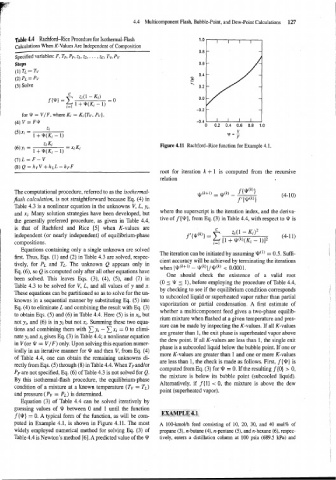
                                                          Figure 4.11  Rachford-Rice  function for Example 4.1.

       (7)L=F-V
       (8)Q=hvv+h~L-h.~F
                                                          root  for  iteration  k + 1  is  computed  from  the  recursive
                                                          relation

      The computational procedure, referred to as the isothermal-      *(kt"   = q(k)   f f( qck)}
      flash  calculation, is not straightforward because Eq. (4) in                  f '{9(k)}       (4- 10)
      Table 4.3 is a nonlinear equation in the unknowns V, L, yi,
                                                          where the superscript is the iteration index, and the deriva-
      and xi, M~~  solution strategies have been developed, but
                                                          tive of f (91, from Eq. (3) in Table 4.4, with respect to Qf is
      the  generally preferred  procedure, as given  in Table 4.4,
      is  that  of  Rachford  and  Rice  [5]  when  K-values  are   f '(~(~'1 x    ~r(l - Ki)'
                                                                             c
 I    independent (or nearly  independent) of  equilibrium-phase          =  i=l [I + q(k)(Ki - I)]'   (4-1 1)
      compositions.
         Equations containing only a single unknown  are solved
                                                          The iteration can be initiated by assuming 9(') = 0.5. Suffi-
      first. Thus, Eqs. (1) and (2) in Table 4.3 are solved, respec-
                                                          cient accuracy will be achieved by terminating the iterations
      tively,  for  PL and  TL. The  unknown  Q  appears  only  in
                                                          when (Q(~+') - q(k)l/9fk) < 0.0001.
      Eq. (6), so Q is computed only after all other equations have
                                                            One  should  check  the  existence  of  a  valid  root
      been  solved.  This  leaves  Eqs.  (3),  (4),  (5),  and  (7)  in
                                                          (0 5 9 5 I), before employing the procedure of Table 4.4,
      Table 4.3 to be  solved for V, L, and all values of y and x.
                                                          by checking to see if the equilibrium condition corresponds
      These equations can be partitioned so as to solve for the un-
                                                          to subcooled liquid or superheated vapor rather than partial
      knowns in a sequential manner by substituting Eq. (5) into
                                                          vaporization  or  partial  condensation. A  first  estimate  of
      Eq. (4) to eliminate L and combining the result with Eq. (3)
                                                          whether a multicomponent feed gives a two-phase equilib-
      to obtain Eqs. (5) and (6) in Table 4.4. Here (5) is in xi, but
                                                          rium mixture when flashed at a given temperature and pres-
      not yi, and (6) is in yi but not xi. Summing these two equa-
                                                          sure can be made by inspecting the K-values. If all K-values
      tions and combining them with C yi  - C xi  = 0 to elimi-
                                                          are greater than 1, the exit phase is superheated vapor above
      nate yi and xi gives Eq. (3) in Table 4.4; a nonlinear equation
                                                          the dew point. If all K-values are less than 1, the single exit
      in V (or 9 = V/F) only. Upon solving this equation numer-
                                                          phase is a subcooled liquid below the bubble point. If one or
      ically in an iterative manner for 9 and then V, from Eq. (4)
                                                          more K-values are greater than 1 and one or more K-values
      of  Table 4.4, one can obtain the remaining  unknowns di-
                                                          are less than 1, the check is made as follows. First, f {9] is
      rectly from Eqs. (5) through (8) in Table 4.4. When TF and/or
                                                          computed from Eq. (3) for   = 0. If the resulting f (0) > 0,
      PF are not specified, Eq. (6) of Table 4.3 is not solved for Q.
                                                          the  mixture is  below  its  bubble  point  (subcooled  liquid).
      By  this  isothermal-flash procedure, the  equilibrium-phase
                                                          Alternatively, if  f {1} < 0,  the  mixture is  above  the  dew
      condition of  a mixture at a known temperature (Tv = TL)
                                                          point (superheated vapor).
      and pressure ( Pv = PL) is determined.
         Equation (3) of  Table 4.4  can be  solved iteratively by
      guessing values of  \I, between  0 and  1 until the function
      f (9) = 0. A typical form of  the function, as will be com-
      puted in ~xa$le  4.1, is shown in Figure 4.11. The most   A  100-hofi feed  consisting of  10, 20,  30, and  40  mol% of   I
      widely employed numerical method for solving Eq. (3) of   propane (3), n-butane (4), n-pentane (3, and n-hexane (6), respec-
      Table 4.4 is Newton's method [6]. A predicted value of the \I,   tively, enters  a distillation column  at  100 psia  (689.5 kPa) and

