


Page 158 - Separation process principles 2
P. 158
4.3  Azeotropic Systems  123


       ~f the  pressures are sufficiently  low  that  the  equilibrium-   4.3  AZEOTROPIC SYSTEMS
       vapor phase is ideal and the curve is convex, deviations from
                                                          Departures  from  Raoult's  law  frequently  manifest  them-
       ~aoult's law are positive, and species liquid-phase activity
                                                          selves in the formation of azeotropes, particularly for mix-
       coefficients  are greater than 1; if the curve is concave, devi-
                                                          tures  of  close-boiling species of  different chemical types
       ations are negative and activity coefficients are less than  1.
                                                          whose liquid solutions are nonideal. Azeotropes are formed
       In either case, the total pressure is given by
                                                          by  liquid  mixtures  exhibiting  maximum-  or  minimum-
                                +
                     P  = YAP~XA YBP~XB           (4-7)   boiling points. These represent, respectively, negative or pos-
                                                          itive deviations from Raoult's law. Vapor and liquid compo-
       ~f the vapor does not obey the ideal-gas law, (4-7) does not
                                                          sitions are identical at the azeotropic composition; thus, all
       apply. In Figure 4.2~ system pressures are sufficiently high
                                                          K-values are 1 and no separation of  species can take place.
       that some deviation from the ideal-gas law occurs. However,
                                                            If only one liquid phase exists, the mixture forms a hom-
       the convexity is due mainly to activity coefficients that are
                                                          ogeneous azeotrope; if more than one liquid phase is present,
       greater than 1.
                                                          the  azeotrope  is  heterogeneous.  In  accordance  with  the
         For  relatively  close  (narrow)-boiling  binary  mixtures
                                                          Gibbs phase rule, at constant pressure in a two-component
       that  exhibit  ideal  or  nearly  ideal  behavior,  the  relative
                                                          system, the vapor can coexist with no more than two liquid
       volatility, CIA,B, varies  little  with  pressure.  If  (YA,B  is  as-
                                                          phases, while in a ternary mixture up to three liquid phases
       sumed constant over the entire composition range, the y-x
                                                          can coexist with the vapor.
       phase-equilibrium  curve  can  be  determined  and  plotted
                                                            Figures 4.6, 4.7, and 4.8 show three types of azeotropes
       from a rearrangement of (4-5):
                                                          that are commonly encountered with binary mixtures. The
                                                          most common type by far is the minimum-boiling homoge-
                                                          neous azeotrope, illustrated in Figure 4.6 for the isopropyl
                                                          ether-isopropyl  alcohol system. In Figure 4.6a, for a tem-
      For  an  ideal  solution,  aA,J  can  be  approximated  with   perature of 70°C, the maximum total pressure is greater than
      Raoult's law to give                                the vapor pressure of either component because activity co-
                                                          efficients are greater than 1. The y-x  diagram in Figure 4.6b
                                                          shows that for a pressure of  1 atm the azeotropic mixture
                                                          occurs at 78 mol% ether. Figure 4.6~ is a T-x  diagram for a
      Thus,  from  a  knowledge  of  just  the  vapor  pressures  of   pressure of  101 kPa, where the azeotrope is seen to boil at
      the two components at a temperature, say, midway between   66°C. In Figure 4.6a, for 70°C, the azeotrope, at  123 kPa   I
      the two boiling points at the given pressure, a y-x  phase-   (923 torr), is 72 mol% ether. Thus, the azeotropic composi-   i
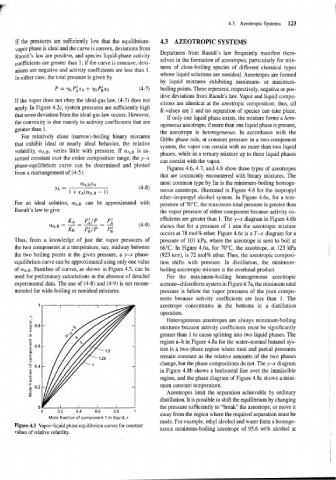
      equilibrium curve can be approximated using only one value   tion  shifts  with  pressure.  In  distillation,  the  minimum-
      of O~A,B. Families of curves, as shown in Figure 4.5, can be   boiling azeotropic mixture is the overhead product.
      used for preliminary calculations in the absence of detailed   For  the  maximum-boiling  homogeneous  azeotropic
      experimental data. The use of (4-8) and (4-9) is not recom-   acetone-chloroform system in Figure  4.7a, the minimum total
      mended for wide-boiling or nonideal mixtures.       pressure is below the vapor pressures of  the pure compo-
                                                          nents  because  activity  coefficients are  less  than  1. The
                                                          azeotrope  concentrates  in  the  bottoms  in  a  distillation
                                                          operation.
                                                            Heterogeneous azeotropes are always minimum-boiling
                                                          mixtures because activity coefficients must be significantly
                                                          greater than 1 to cause splitting into two liquid phases. The
                                                          region a-b  in Figure 4.8a for the water-normal  butanol sys-
                                                          tem is a two-phase region where total and partial pressures
                                                          remain constant as the relative amounts of  the two phases
                                                          change, but the phase compositions do not. The y-x  diagram
                                                          in Figure 4.8b shows a horizontal line over the immiscible
                                                          region, and the phase diagram of Figure 4.8~ shows a mini-
                                                          mum constant temperature.
                                                            Azeotropes limit the separation achievable by  ordinary
                                                          distillation. It is possible to shift the equilibrium by changing
               "                                          the pressure sufficiently to "break" the azeotrope, or move it
                0     0.2   0.4    0.6   0.8     1
                                                          away from the region where the required separation must be
                   Mole fraction of component 1 in liquid, x
                                                          made. For example, ethyl alcohol and water form a homoge-
      Figure 4.5  Vapor-liquid  phase equilibrium curves for constant   neous minimum-boiling azeotrope of  95.6 wt%  alcohol at
      values of relative volatility.

