


Page 155 - Separation process principles 2
P. 155
120  Chapter 4  Single Equilibrium Stages and Flash Calculations


                   UA,B  depends on T, P, and the compositions of the equilib-   Table 4.2  Vapor-Liquid  Equilibrium Data for the
                   rium vapor and liquid. At 1 atm, where %,B  is approximated   Methanol-Water  System at Temperatures of 50, 150,
                                                                           and 250°C
                   well by yAPL/yB Pi, UA,B  depends only on T and XA, since
                   vapor-phase nonidealities are small. Because of the depen-   a.  Methanol (A)-Water  (B) System
                   dency on xA, aA,B is not a constant, but varies from point to   T = 50°C
                   point. For the three binary systems in Table 4.1, the vapor   Data of McGlashan and Williamson,
                   and liquid phases become richer in the less-volatile compo-   J. Chem. Eng. Data, 21, 196 (1976)
                   nent, B, as temperature increases. For XA = 1, the tempera-   Pressure, psia   YA   XA     ~A,B
                   ture is the normal boiling point of A; for xA = 0, the temper-
                                                                              1.789       0.0000    0.0000
                   ature is the normal boiling point of B. For the three systems,
                                                                              2.373       0.2661    0.0453
                   all other data points are at temperatures between the two
                                                                              2.838       0.4057    0.0863
                   boiling points. Except for the pure components (XA = 1 or 0),
                                                                              3.369       0.5227    0.1387
                   YA > xA and CYA,B  > 1.                                    3.764       0.5898    0.1854
                     For the water-glycerol  system, the difference in normal   4.641     0.7087    0.3137
                   boiling points is 190°C. Therefore, relative volatility values   5.163   0.7684   0.4177
                   are very high, making it possible to  achieve a reasonably   5.771     0.8212    0.5411
                                                                              6.122       0.8520    0.6166
                   good separation in a single equilibrium stage. Industrially,
                                                                              6.811       0.9090    0.7598
                   the  separation is often conducted in an evaporator, which
                                                                              7.280       0.9455    0.8525
                   produces a nearly pure water vapor and a glycerol-rich liq-
                                                                              7.800       0.9817    0.9514
                   uid.  For  example,  from  Table  4.1,  at  207"C,  a  vapor  of   8.072   1  .OOOO   0.0000
                   98 mol% water is in equilibrium with a liquid phase contain-
                                                                           b.  Methanol (A)-Water  (B) System
                   ing more than 90 mol% glycerol.
                                                                             T = 150°C
                     For the methanol-water  system, the difference in nor-
                                                                             Data of Griswold and Wong, Chem. Eng.
                   mal  boiling  points  is  35.5"C.  As  a  result,  the  relative
                                                                             Prog. Symp. Ser, 48 (3), 18 (1952)
                   volatility  is  an  order  of  magnitude  lower  than  for  the
                   water-glycerol  system. A sharp separation cannot be made   Pressure, psia   YA    XA      ~A,B
                   with a single stage. About 30 trays are required in a distil-
                   lation  operation  to  obtain  a 99 mol%  methanol  distillate
                   and  a  98  mol%  water  bottoms,  an  acceptable  industrial
                   separation.
                     For the aromatic paraxylene-metaxylene isomer system,
                   the normal boiling-point difference is only 0.8"C. Thus, the
                   relative volatility is very close to 1.0, making the separation
                   by distillation impractical because about 1,000 trays are re-
                   quired to produce nearly pure products. Instead, crystalliza-
                   tion and adsorption, which have much higher separation fac-
                   tors, are used commercially to make the separation.
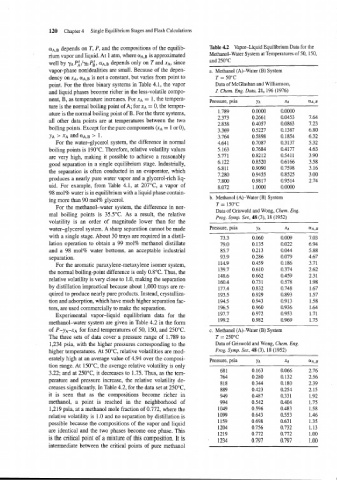
                     Experimental  vapor-liquid  equilibrium  data  for  the
                   methanol-water  system are given in Table 4.2 in the form
                   of P-yA-xA  for fixed temperatures of 50, 150, and 250°C.   c. Methanol (A)-Water  (B) System
                   The three sets of  data cover a pressure range of  1.789 to   T = 250°C
                   1,234 psia, with the higher pressures corresponding to the   Data of Griswold and Wong, Chem. Eng.
                   higher temperatures. At 50°C relative volatilities are mod-   Prog. Symp. Ser, 48 (3), 18 (1952)
                   erately high at an average value of 4.94 over the composi-   Pressure, psia   YA   XA      ~A,B
                   tion range. At 150°C, the average relative volatility is only
                   3.22; and at 250°C, it decreases to 1.75. Thus, as the tem-
                   perature  and  pressure  increase,  the  relative  volatility  de-
                   creases significantly. In Table 4.2, for the data set at 250°C,
                   it  is  seen  that  as  the  compositions  become  richer  in
                  methanol,  a  point  is  reached  in  the  neighborhood  of
                   1,219 psia, at a methanol mole fraction of 0.772, where the
                  relative volatility is 1.0 and no separation by distillation is
                  possible because the compositions of the vapor and liquid
                   are identical and the two phases become one phase. This
                  is the critical point of a mixture of  this composition. It is
                  intermediate between the critical points of  pure methanol

