


Page 154 - Separation process principles 2
P. 154
4.2  Binary Vapor-Liquid  Systems  119


      counted as variables because they are thermodynamic func-   Table 4.1  Vapor-Liquid  Equilibrium Data for
      tions that depend on intensive variables.               Three Common Binary Systems at 1 atm Pressure
         For  the  general degrees-of-freedom analysis for  phase   a.  Water (A)-Glycerol  (B) System
      equilibrium, with C components, 9 phases, and a single feed   P = 101.3 kPa
      phase, (4-2) and (4-3) are extended by adding the number of   Data of Chen and Thompson, J.  Chem. Eng.
      additional variables and equations, respectively:          Data, 15,471 (1970)

                                                              Temperature, OC


      For example, if  the C + 5 degrees of  freedom are used  to
      specify all zi and the five variables F, TF, PF, T, and P, the
      remaining variables are computed from the equations shown
      in Figure 4.1.' To apply the Gibbs phase rule, (4-l), the num-
      ber  of  phases  must  be  known. When  applying  (4-4), the
      determination of  the  number of  equilibrium phases, 9, is
      implicit in the computational procedure as illustrated in later
      sections of this chapter.
        In the following sections, the Gibbs phase rule, (4-l), and
      the equation for the number of degrees of freedom of a flow
      system, (4-4), are applied  to  (1) tabular equilibrium data,   b.  Methanol (A)-Water  (B) System
      (2)  graphical  equilibrium  data,  or  (3)  thermodynamic   P = 101.3 kPa
      equations  for  K-values  and  enthalpies  for  vapor-liquid,   Data of J.G. Dunlop, M.S. thesis, Brooklyn
                                                                 Polytechnic Institute (1948)
      liquid-liquid,  solid-liquid,  gas-liquid,  gas-solid,  vapor-
      liquid-solid,  and vapor-liquid-liquid  systems at equilibrium.   Temperature, "C   yA   XA   ~A,B


      4.2  BINARY VAPOR-LIQUID  SYSTEMS
      Experimental  vapor-liquid  equilibrium  data  for  systems
      containing two components, A and B, are widely available.
      Sources include Perry's  Handbook [I] and Gmehling and
      Onken [2]. Because y~ = 1 - y~ and XB  = 1 - XA, the data
      are presented in terms of just four intensive variables: T, P,
      y~, and XA. Most commonly T, y~, and XA are tabulated for a
      fixed P  for ranges of  y~ and XA  from 0 to  1, where A is
      the  more-volatile  component  (yA > xA). However,  if  an
      azeotrope (see  Section 4.3)  forms,  B  becomes  the  more
      volatile component on one side of the azeotropic point. By
      the Gibbs phase rule, (4-I), 3 = 2 - 2 + 2 = 2. Thus, with
      pressure fixed, phase compositions are completely defined if
      temperature is also fixed, and the separation factor, that is,
      the relative volatility in the case of vapor-liquid  equilibria,   c.  Para-xylene (A)-Meta-xylene  (B) System
                                                                P = 101.3 kPa
                                                                Data of Kato, Sato, and Hirata, J. Chem.
                                                                Eng. Jpn., 4,305 (1970)
                                                                                 -
                                                              Temperature, "C   y~       XA      ~A,B
      is also fixed.
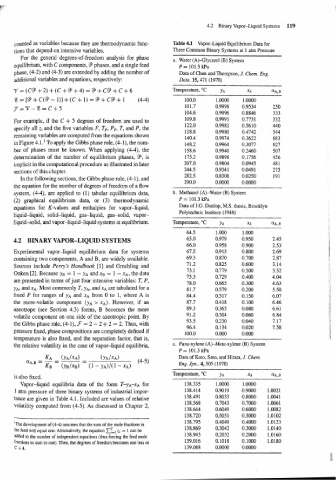
        Vapor-liquid  equilibria  data  of  the  form  T-y~-XA for   138.335   1  .OOOO   1 .OOOO
      1 atm pressure of three binary systems of industrial impor-   138.414   0.9019   0.9000   1.0021
      tance are given in Table 4.1. Included are values of relative   138.491   0.8033   0.8000   1.0041
      volatility  computed from (4-5). As discussed in Chapter 2,   138.568   0.7043   0.7000   1.0061
                                                                  138.644    0.6049    0.6000   1.0082
                                                                  138.720    0.5051    0.5000   1.0102
                                                                  138.795    0.4049    0.4000   1.0123
      'The development of (4-4) assumes that the sum of the mole fractions in
                                                                  138.869    0.3042    0.3000   1.0140
      the feed will equal one. Alternatively, the equation zE1 zi = 1 can be
                                                                  138.943    0.2032    0.2000   1.0160
      added to the number of independent equations (thus forcing the feed mole
      fractions to sum to one). Then, the degrees of freedom becomes one less or   139.016   0.1018   0.1000   1.0180
      c+4.                                                        139.088    0.0000    0.0000
                                                                                                                      (I!
                                                                                                                      1I1lI

