


Page 167 - Separation process principles 2
P. 167
132  Chapter 4  Single Equilibrium Stages and Flash Calculations


                 When  values  of xi are  small,  Kb  approaches KD. As  dis-   devised to determine the equilibrium compositions. Exam-
                 cussed in Chapter 2, the distribution coefficient, KD,, which   ples  of  phase  diagrams are  shown  in  Figure  4.14  for the
                 can be  determined from activity  coefficients using the ex-   water (A)-ethylene  glycol (B)-furfural  (C) system at 25OC
                 pression KDB = yz)/yA1) when mole fractions are used, is a   and a pressure of  101 kPa, which is above the bubble-point
                 strong function of equilibrium-phase compositions and tem-   pressure, so no vapor phase exists. Experimental data for this
                 perature.  However,  when the raffinate and extract are both   system were obtained by Conway and Norton [18]. The pairs
                 dilute in the solute, aclivity coefficients of the solute can be   water-ethylene glycol and furfural-ethylene  glycol are each
                 approximated by the values at infinite dilution so that KDB   completely  miscible.  The  only  partially  miscible  pair  is
                 can be taken as a constant at a given temperature. An exten-   furfural-water. Furfural might be used as a solvent to remove
                 sive listing of such KDB values in mass fraction units for var-   the  solute,  ethylene  glycol,  from  water;  the  furfural-rich
                 ious ternary  systems is given  in Perry's Handbook  [9]. If   phase is the extract, and the water-rich phase is the raffinate.
                 values for FB, xr), St and  KD, are given,  (4-25) can be   Figure  4.14a,  an  equilateral-triangular  diagram,  is  the
                 solved for xF).                                     most common display of ternary liquid-liquid  equilibrium
                                                                     data in the chemical literature. Any point located within or
                                                                     on an edge of the triangle represents a mixture composition.
                                                                     Such a diagram has the property that the sum of the lengths
                                                                     of the perpendicular lines drawn from any interior point to
                 A feed of  13,500 kglh consists of  8 wt% acetic acid (B) in water
                                                                     the sides equals the altitude of the triangle. Thus, if each of
                 (A). The  removal  of  the  acetic  acid  is  to  be  accomplished  by
                 liquid-liquid  extraction at 25OC  with methyl isobutyl ketone sol-   the three altitudes is scaled from 0 to 100, the percent of, say,
                 vent (C), because distillation of the feed would require vaporization   furfural, at any point such as M, is simply the length of the
                 of large amounts of water. If the raffinate is to contain only 1 wt%   line  perpendicular  to  the  base  opposite  the  pure  furfural
                 acetic acid, estimate the kilograms per hour of solvent required if a   apex, which represents  100% furfural. Figure 4.14a is con-
                 single equilibrium stage is used.                   structed for compositions based on mass fractions (mole frac-
                                                                     tions and volume fractions are also sometimes used). Thus,
                 SOLUTION                                            the point  M  in Figure 4.14a  represents  a  mixture  of  feed
                                                                     and solvent (before phase separation) containing 18.9 wt%
                 Assume  that  the  camer  (water) and  the  solvent are immiscible.
                                                                     water, 20 wt% ethylene glycol, and 61.1 wt% furfural.
                 From Perry S Handbook, take KD = 0.657 in mass-fraction units for
                 this system. For the relatively low concentrations of acetic acid in   The miscibility limits for the furfural-water  binary system
                 this problem, assume that Kb = KD.                  are at D and G. The miscibility boundary (saturation or binodal
                                                                     curve) DEPRG can be obtained experimentally by a cloud-
                                                                    point titration; water, for example, is added to a (clear) 50 wt%
                                                                     solution of furfural and glycol, and it is noted that the onset of
                                                                    cloudiness due to the formation of a second phase occurs when
                 The raffinate is to contain 1 wt% B. Therefore,
                                                                    the mixture is 11  % water, 44.5% furfural, and 44.5% glycol by
                             xp = 0.01/(1 - 0.01) = 0.0101          weight. Other miscibility data are given in Table 4.5, from
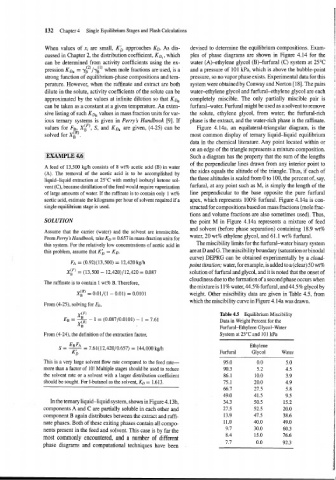
                                                                    which the miscibility curve in Figure 4.14a was drawn.
                 From (4-25), solving for EB,
                             xf)                                               Table 4.5  Equilibrium Miscibility
                                   1
                        EB = 3 = (0.087/0.0101)  - 1 = 7.61                    Data in Weight Percent for the
                                 -
                             XB                                                Furfural-Ethylene Glycol-Water
                 From (4-24), the definition of the extraction factor,         System at 2S°C and 101 kPa
                                                                                          Ethylene
                                                                               Furfural    Glycol    Water
                 This is a very large solvent flow rate compared to the feed rate-
                 more than a factor of lo! Multiple stages should be used to reduce
                 the solvent rate or a solvent with a larger distribution coefficient
                 should be sought. For 1-butanol as the solvent, KD = 1.613.


                   In the ternary liquid-liquid  system, shown in Figure 4.13b,
                 components A and C are partially soluble in each other and
                 component B again distributes between the extract and raffi-
                 nate phases. Both of these exiting phases contain all compo-
                 nents present in the feed and solvent. This case is by far the
                 most  commonly  encountered, and  a  number  of  different
                 phase  diagrams  and  computational  techniques  have  been

