


Page 172 - Separation process principles 2
P. 172
4.6  Multicomponent Liquid-Liquid  Systems  137


       4.6  MULTICOMPONENT                                  Most  liquid-liquid  equilibria  are  achieved  under  adia-
       LIQUID-LIQUID SYSTEMS                              batic conditions, thus necessitating  consideration of  an en-
                                                          ergy  balance.  However,  if  both feed and  solvent enter the
       Quarternary and higher multicomponent mixtures are often   stage at identical temperatures, the only energy effect is the
       encountered  in  liquid-liquid  extraction  processes,  particu-   heat of mixing, which is often sufficiently small that only a
       larly when two solvents are used for liquid-liquid  extraction.   very small temperature change occurs. Accordingly, the cal-
       As  discussed  in  Chapter  2,  multicomponent  liquid-liquid   culations are often made isothermally.
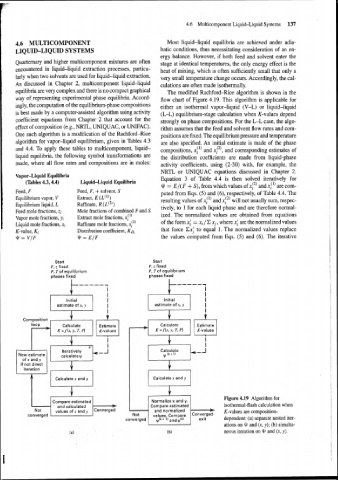
       equilibria are very complex and there is no compact graphical   The modified Rachford-Rice  algorithm is shown in the
       way of representing experimental phase equilibria. Accord-   flow chart of Figure 4.19. This algorithm is applicable for
       ingly, the computation of the equilibrium-phase compositions   either  an  isothermal  vapor-liquid  (V-L)  or  liquid-liquid
       is best made by a computer-assisted algorithm using activity   (L-L)  equilibrium-stage  calculation when K-values depend
       coefficient equations  from  Chapter  2  that  account  for  the   strongly on phase compositions. For the L-L  case, the algo-
       effect of composition (e.g., NRTL, UNIQUAC, or UNIFAC).   rithm assumes that the feed and solvent flow rates and com-
       One such algorithm is a modification of  the Rachford-Rice   positions are fixed. The equilibrium pressure and temperature
       algorithm for vapor-liquid  equilibrium, given in Tables 4.3   are also specified. An initial estimate is made of the phase
       and 4.4.  To apply these  tables  to  multicomponent,  liquid-   compositions, xi') and xiZ), and corresponding estimates of
       liquid equilibria, the following  symbol transformations  are   the  distribution  coefficients  are  made  from  liquid-phase
       made, where all flow rates  and compositions  are in moles:   activity  coefficients,  using  (2-30)  with,  for  example,  the
                                                          NRTL  or  UNIQUAC  equations  discussed  in  Chapter  2.
       Vapor-Liquid Equilibria
                                                          Equation  3  of  Table  4.4  is  then  solved  iteratively  for
          (Tables 4.3,4.4)    Liquid-Liquid  Equilibria
                                                          Q = E/(F + S), from which values of xi2) and x:')  are com-
  I    Feed, F               Feed, F, + solvent, S        puted from Eqs. (5) and (6), respectively, of Table 4.4. The
  j    Equilibrium vapor, V   Extract, E (L('))           resulting values of x:')  and x,(')  will not usually sum, respec-
       Equilibrium liquid, L   Raffinate, R (L(~))
       Feed mole fractions, z,   Mole fractions of combined F and S   tively, to  1 for each liquid phase and are therefore normal-
       Vapor mole fractions, y,   Extract mole fractions, x,(')   ized. The normalized  values  are  obtained  from  equations
                                                          of the form x:  = x, / C x,,  where xi are the normalized values
       Liquid mole fractions, x,   Raffinate mole fractions, x,(~)
       K-value, K,           Distribution coefficient, KD,   that force  Cxl to equal  1. The normalized  values replace
       \Ir  = V/F            q = E/F                      the  values computed  from Eqs. (5) and  (6). The iterative


                     Start                             Start
                   F, z fixed                         F, z fixed
                   P, Tof equilibrium                 P, T of equilibrium
                   phases fixed                       phases fixed


                                                           Initial
                     estimate of x, y
         Composition A
                                   &,
                       Calculate    Estimate              Calculate    Estimate


                       Iteratively                        Calculate
        New estimate   calculatev
       I  if not direct  I
                                                      r-l
          iteration       .I
                                                       Calculate x and y
       71 Calculate x and y


                                                                                Figure 4.19  Algorithm for
                    Compare estimated                  Normalize x and y.
                      and calculated                   Compare estimated        isothermal-flash calculation when
                                                        and normalized          K-values are composition-
           converged
                                              converged  I              exit    dependent: (a) separate nested iter-
                                                                                ations on q and (x, y); (b) simulta-
                                                                                neous iteration on \I, and (x, y).

