


Page 177 - Separation process principles 2
P. 177
142  Chapter 4  Single Equilibrium Stages and Flash Calculations


                      60   l  I  I  I  I  I  D  I  I  I  I  I  I  I  I  I  I  I  I  I
                        -                                                      -
                                                                               -
                      50   -   Homogeneous           Solid Na2S04 + solution
                        -     solution                                         -
                        -                                                      -
                      40                      C
                        -
                    9                                                         H -
                                                                               -
                                                                               -
                                                                               -
                                                                               -
                                                     Solids - Na2S04 + Na2S0,.IOH,0
                                                                               -
                                                                               -
                                                                               -
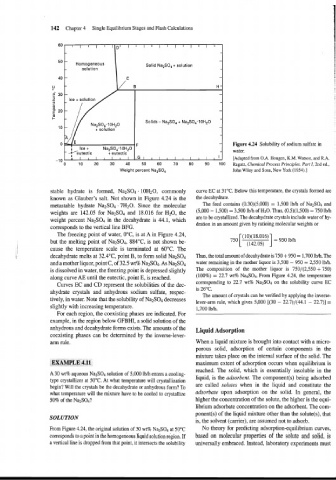
                                                 F                                  Figure 4.24  Solubility of sodium sulfate in
                              lce +   Na2S04~10H20
                        - Heutectic     + eutectic                             -    water.
                                                  G  I  I  I  I  I  I  I  I  I  I  ~ [Adapted from O.A. Hougen, K.M. Watson, and R.A.
                        0    10    20   30    40   50    60    70   80    90   100   Ragatz, Chemical Process Principles. Part I, 2nd ed.,
                                            Weight percent Na2S04                   Joh11 Wiley and Sons, New York (1954).]


                   stable  hydrate  is  formed,  Na2S04. 10H20,  commonly   curve EC at 31°C. Below this temperature, the crystals formed are
                   known  as Glauber's  salt. Not  shown in Figure 4.24  is the   the decahydrate.
                   metastable  hydrate  Na2S04 . 7H20.  Since  the  molecular   The feed contains (0.30)(5,000) = 1,500 lb/h of  Na2S04 and
                                                                       (5,000  - 1,500) = 3,500 lb/h of H20. Thus, (0.5)(1,500) = 750 lb/h
                   weights  are  142.05 for  Na2S04 and  18.016 for H20, the
                                                                       are to be crystallized. The decahydrate crystals include water of hy-
                   weight  percent  Na2S04 in the  decahydrate  is 44.1,  which
                                                                       dration in an amount given by ratioing molecular weights or
                   corresponds to the vertical line BFG.
                     The freezing point of water, O°C, is at A in Figure 4.24,
                   but  the melting point  of  Na2S04, 884"C, is not shown be-
       I           cause  the  temperature  scale  is  terminated  at  60°C.  The
       I           decahydrate melts at 32.4"C, point B, to form solid Na2S04   Thus, the total amount of decahydrate is 750 + 950 = 1,700 lblh. The
                   and a mother liquor, point C, of 32.5 wt% Na2S04. As Na2S04   water remaining in the mother liquor is 3,500 - 950 = 2,550 lbih.
                   is dissolved in water, the freezing point is depressed slightly   The  composition  of  the  mother  liquor  is  750/(2,550 + 750)
                   along curve AE until the eutectic, point E, is reached.   (100%) = 22.7 wt% Na4S04. From Figure 4.24, the temperature
                     Curves EC and CD represent the solubilities of the dec-   corresponding to  22.7  wt% Na2S04 on  the  solubility  curve EC
                                                                       is 26°C.
                   ahydrate  crystals  and  anhydrous  sodium  sulfate,  respec-
                                                                         The amount of crystals can be verified by applying the inverse-
                   tively, in water. Note that the solubility of Na2S04 decreases
                                                                       lever-arm rule, which gives 5,000 [(30 - 22.7)/(44.1 - 22.7)] =
                   slightly with increasing temperature.               1,700 lbih.
                     For each region, the coexisting phases are indicated. For
                   example, in the region below GFBHI, a solid solution of the
                   anhydrous and decahydrate forms exists. The amounts of the
                                                                      Liquid Adsorption
                   coexisting phases can be  determined by  the inverse-lever-
                   arm rule.                                          When a liquid mixture is brought into contact with a micro-
                                                                      porous  solid,  adsorption  of  certain  components  in  the
                                                                      mixture takes place on the internal surface of the solid. The
                                                                      maximum extent of adsorption occurs when equilibrium is
                                                                      reached.  The  solid,  which  is  essentially  insoluble  in  the
                   A 30 wt% aqueous Na2S04 solution of 5,000 lbih enters a cooling-
                   type crystallizer at 50°C. At what temperature will crystallization   liquid, is the adsorbent. The component(s) being adsorbed
                   begin? Will the crystals be the decahydrate or anhydrous form? To   are  called  solutes  when  in  the  liquid  and  constitute  the
                   what temperature will the mixture have to be cooled to crystallize   adsorbate  upon  adsorption  on  the  solid.  In  general,  the
                   50% of the Na2S04?                                 higher the concentration of the solute, the higher is the equi-
                                                                      librium adsorbate concentration on the adsorbent. The com-
                                                                      ponent(~) of the liquid mixture other than the solute(s), that
                   SOLUTION
                                                                      is, the solvent (carrier), are assumed not to adsorb.
                   From Figure 4.24, the original solution of 30 wt% Na2S04 at 50°C   No theory  for predicting adsorption-equilibrium  curves,
                   corresponds to a point in the homogeneous liquid solution region. If   based  on molecular properties of  the  solute and  solid, is
                   a vertical line is dropped from that point, it intersects the solubility   universally embraced. Instead, laboratory experiments must

