


Page 179 - Separation process principles 2
P. 179
144  Chapter 4  Single Equilibrium Stages and Flash Calculations


                  SOLUTION                                           condensed to a liquid. In this section, the physical equilib-
                                                                     rium of gas-liquid  mixtures is considered.
                  From the data given, c(~) 10 mrnolk, Q = 1 L, and S = 5 g.
                                    =
                                                                       Even though components of  a gas mixture are at a tem-
                  (a) Graphical  method.  From  (4-29),  q;  = - ($) CB + 10 (4) =   perature above critical, they can dissolve in an appropriate
                          +
                     -0.2~~ 2
                                                                     liquid solvent to an extent that depends on the temperature
                     This equation, with a slope of -0.2  and an intercept of 2, when   and their partial pressure in the gas mixture. With good mix-
                     plotted on Figure 4.25, yields an intersection with the equilib-
                                                                     ing, equilibrium between the two phases can be achieved in
                     rium  curve  at  qi = 1.9 rnrnoYg  and  CB  = 0.57  mmoMiter.   a short time unless the liquid is very viscous.
                    Thus, the percent adsorption of phenol is
                                                                       Unlike equilibrium vapor-liquid  mixtures, where, as dis-
                                                                     cussed in Chapter 2,  a number of  theoretical relationships
                                                                     are in use for estimating K-values from molecular proper-
                                                                     ties, no  widely  accepted theory  exists for gas-liquid  mix-
                  (b)  Numerical algebraic method. Applying Eq. (1) from the prob-   tures. Instead, experimental data, plots of experimental data,
                     lem statement and (4-31),
                                                                     or empirical correlations are used.
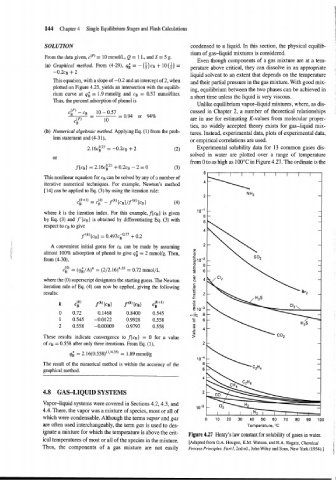
                                                                       Experimental solubility data for  13 common gases dis-
                                                                     solved  in  water  are  plotted  over  a  range  of  temperature
                                                                     from 0 to as high as 100°C in Figure 4.27. The ordinate is the


                 This nonlinear equation for c~ can be solved by any of a number of
                 iterative  numerical  techniques.  For  example,  Newton's  method
                  [14] can be applied to Eq. (3) by using the iteration rule:


                 where  k  is  the  iteration  index. For  this  example, f{cB] is given
                 by Eq. (3) and  ~'{cB] is obtained by differentiating Eq. (3) with
                 respect to CB to give


                    A convenient  initial guess  for  CB  can be  made  by  assuming
                 almost  100% adsorption of phenol to give q;f  = 2 mmol/g. Then,
                 from (4-30),


                 where the (0) superscript designates the starting guess. The Newton
                 iteration rule of Eq. (4) can now be applied, giving the following
                 results:


                 These  results  indicate  convergence  to flcB] = 0  for  a  value
                 of CB = 0.558 after only three iterations. From Eq. (I),


                 The result of the numerical method is within the accuracy of the
                 graphical method.


                 4.8  GAS-LIQUID  SYSTEMS
                 Vapor-liquid  systems were covered in Sections 4.2,4.3, and
                 4.4. There, the vapor was a mixture of species, most or all of
                 which were condensable. Although the terms vapor and gas   0   10  20  30   40  50  60  70  80  90  100
                 are often used interchangeably, the term gas is used to des-            Temperature,  "C
                 ignate a mixture for which the temperature is above the crit-
                                                                     Figure 4.27  Henry's law constant for solubility of gases in water.
                 ical temperatures of most or all of the species in the mixture.
                                                                     [Adapted from O.A. Hougen, K.M. Watson, and R.A. Ragatz, Chemical   i
                 Thus,  the  components  of  a  gas  mixture  are  not  easily   Process Principles. Parrl, 2nd ed., John Wiley and Sons, New York (1954).]   '
                                                                                                                        I

