


Page 169 - Separation process principles 2
P. 169
134  Chapter 4  Single Equilibrium Stages and Flash Calculation


                                                                      rium system are temperature, pressure, and the concentra-
                                                                      tions  of  the  components  in  each  phase. According  to the
                                                                      phase rule,  (4-I), for a three-component, two-liquid-phase
                                                                      system, there are three degrees of freedom. At constant tem-
                                                                      perature and pressure, specification  of  the concentration  of
                                                                      one component in either of the phases suffices to completely
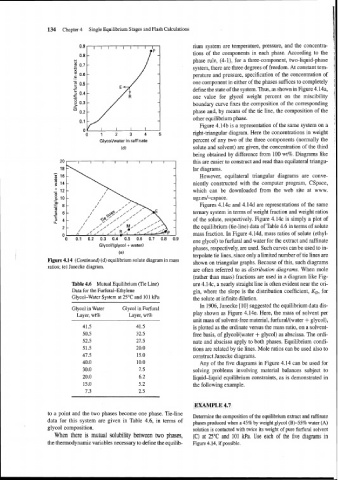
                                                                      define the state of the system. Thus, as shown in Figure 4.14a,
                                                                      one  value  for  glycol  weight  percent  on  the  miscibility
                                                                      boundary curve fixes the composition of the corresponding
                                                                      phase and, by means of  the tie line, the composition of the
                                                                      other equilibrium phase.
                                                                        Figure 4.14b is a representation of the same system on a
                                0    1    2    3     4    5           right-triangular diagram. Here the concentrations in weight
                                     Glycollwater in raffinate        percent  of any two of  the three components  (normally the
                                            (d)                       solute and solvent) are given, the concentration of the third
                                                                      being obtained by difference from 100 wt%. Diagrams like
                                                                      this are easier to construct and read than equilateral triangu-
                                                                      lar diagrams.
                                                                        However,  equilateral  triangular  diagrams  are  conve-
                                                                      niently  constructed with  the  computer program,  CSpace,
                                                                      which  can  be  downloaded  from  the  web  site  at  www.
                                                                      ugr.es/-cspace.
                                                                        Figures 4.14~ and 4.14d  are representations of the same
                                                                      ternary system in terms of weight fraction and weight ratios
                                                                      of the solute, respectively.  Figure 4.14~ is simply a plot of
                                                                      the equilibrium (tie-line) data of Table 4.6 in terms of solute
                                                                      mass fraction. In Figure 4.14d, mass ratios of solute (ethyl-
                                                                      ene glycol) to furfural and water for the extract and raffinate
                                     Glycol/(glycol + water)
                                                                      phases, respectively, are used. Such curves can be used to in-
                                            (e)
                                                                      terpolate tie lines, since only a limited number of tie lines are
                  Figure 4.14 (Continued) (d) equilibrium solute diagram in mass   shown on triangular graphs. Because of this, such diagrams
                  ratios; (e) Janecke diagram.
                                                                      are often referred to as distribution diagrams. When mole
                                                                      (rather than mass) fractions are used in a diagram like Fig-
                           Table 4.6  Mutual Equilibrium (Tie Line)   ure 4.14c, a nearly straight line is often evident near the ori-
                           Data for the Furfural-Ethylene             gin, where the slope is the distribution coefficient,  KD, for
                           Glycol-Water  System at 25°C and 101 kPa   the solute at infinite dilution.
                                                                        In 1906, Janecke [lo] suggested the equilibrium data dis-
                           Glycol in Water   Glycol in Furfural
                             Layer, wt%        Layer, wt%             play  shown as Figure 4.14e.  Here, the mass of solvent per
                                                                      unit mass of solvent-free material, furfural/(water + glycol),
                                                                      is plotted as the ordinate versus the mass ratio, on a solvent-
                                                                      free basis, of glycol/(water + glycol) as abscissa. The ordi-
                                                                      nate and abscissa apply to both phases.  Equilibrium condi-
                                                                      tions are related by tie lines. Mole ratios can be used also to
                                                                      construct Janecke diagrams.
                                                                        Any of the five diagrams in Figure 4.14 can be used for
                                                                      solving  problems  involving  material  balances  subject  to
                                                                      liquid-liquid  equilibrium constraints, as is demonstrated  in
                                                                      the following example.


                                                                      EXAMPLE 4.7
                  to a point and the two phases become one phase. Tie-line
                                                                      Determine the composition of the equilibrium extract and raffinate
                  data  for this  system  are given  in  Table  4.6,  in  terms  of
                                                                      phases produced when a 45% by weight glycol (B)-55% water (A)
                  glycol composition.                                 solution is contacted with twice its weight of pure furfural solvent
                     When  there  is  mutual  solubility between  two phases,   (C)  at  25"   and  101 kPa.  Use  each  of  the  five  diagrams  in
                  the thermodynamic variables necessary to define the equilib-   Figure 4.14, if possible.

