


Page 171 - Separation process principles 2
P. 171
136  Chapter 4  Single Equilibrium Stages and Flash Calculations


                                                                          balances apply:
                                                                          Furfural: 7.1zE + 0.10~~ = 200
                                                                          Glycol: 0.67zE + 0.37zR = 45
                                                                          Solving  these  two  simultaneous  equations,  we  obtain  zE =
                                                                          27g, zR = 73g.
                                                                            Thus,  the  furfural  in  the  extract  = (7.1)(27  g)  = 192 g,
                                                                          the  furfural  in the raffinate = 200 - 192 = 8 g, the  glycol  in
                                                                          the extract = (0.67)(27 g) = 18 g, the glycol in the raffinate =
                                                                         45 - 18 = 27 g, the  water  in  the raffinate = 73 - 27 = 46 g,
                                                                          and the water in the extract = 27 - 18 = 9 g. The total extract
                                                                          is  192 + 27 = 219 g, which is close to the results  obtained in
                                                                         part (a). The raffinate composition and amount can be obtained
                                                                         just as readily.
                                                                                                             --
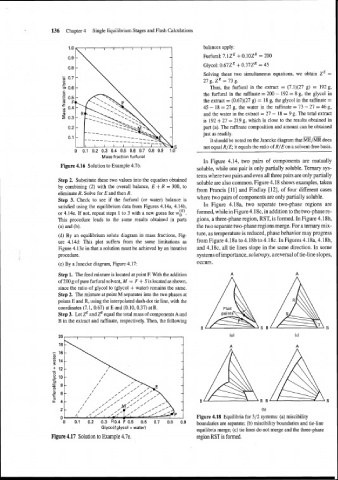
                                                                            It should be noted on the Janecke diagram that ME/MR does
                                                                         not equal RIE; it equals the ratio of RIE on a solvent-free basis.
                                      Mass fraction furfural
                                                                          In  Figure  4.14, two  pairs  of  components are  mutually
                       Figure 4.16  Solution to Example 4.7b.
                                                                       soluble, while one pair is only partially soluble. Ternary sys-
                                                                       tems where two pairs and even all three pairs are only partially
                      Step 2.  Substitute these two values into the equation obtained   soluble are also common. Figure 4.18 shows examples, taken
                      by  combining (2) with the  overall balance,  E + R = 300, to
                                                                       from Francis [ll] and Findlay  [12], of  four different cases
                      eliminate R. Solve for E and then R.
                      Step  3.  Check  to  see  if  the  furfural  (or  water)  balance  is   where two pairs of components are only partially soluble.
                      satisfied using the equilibrium data from Figures 4.14a, 4.14b,   In  Figure  4.18a,  two  separate  two-phase  regions  are
                      or 4.14e. If not, repeat steps 1 to 3 with a new guess for wr).  formed, while in Figure 4.  lac, in addition to the two-phase re-
                      This  procedure  leads  to  the  same  results  obtained  in  parts   gions, a three-phase region, RST, is formed. In Figure 4.  18b,
                      (a) and (b).                                     the two separate two-phase regions merge. For a ternary mix-
                                                                       ture, as temperature is reduced, phase behavior may progress
                      (d) By  an equilibrium solute diagram in mass  fractions, Fig-
                      ure  4.14d:  This  plot  suffers  from  the  same  limitations  as   from Figure 4.18a to 4.18b to 4.18~. In Figures 4.18a, 4. lab,
                      Figure 4.13~ in that a solution must be achieved by an iterative   and 4.18c, all tie lines slope in the same direction. In some
                      procedure.                                       systems of importance, solutropy, areversal of tie-line slopes,
                      (e) By a Janecke diagram, Figure 4.17:           occurs.
                      Step 1.  The feed mixture is located at point F. With the addition
                      of 200 g of pure furfural solvent, M = F + S is located as shown,
                      since the ratio of glycol to (glycol + water) remains the same.
                      Step 2.  The mixture at point M separates into the two phases at
                      points E and R, using the interpolated dash-dot tie line, with the
                      coordinates (7.1, 0.67) at E and (0.10,0.37) at R.
                      Step 3.  Let zE and ZR equal the total mass of components A and
                      B in the extract and raffinate, respectively. Then, the following


                                                                                              (b)
                                                                       Figure 4.18  Equilibria for 312 systems: (a) miscibility
                                                                       boundaries are separate; (b) miscibility boundaries and tie-line
                                     Glycol/(glycol +water)
                                                                       equilibria merge; (c) tie lines do not merge and the three-phase
                    Figure 4.17  Solution to Example 4.7e.             region RST is formed.

