


Page 205 - Separation process principles 2
P. 205
170  Chapter 5  Cascades and Hybrid Systems

                              Makeup
                              absorbent                              Makeup
                            1    I      I                            absorbent
                                                                           +-

                   Absorber
                              -III-I Stripper              Absorber
                  Entering
                                                         Entering
                   vapor                    (e.g.,  steam or
                                           other inert gas)   vapor
                                                                        ,
                                                                         Recycle absorbent
                              Recycle absorbent

                                                  Makeup
                                            q
                                                 absorbent
                                            -

                                     Absorber

                                    Entering
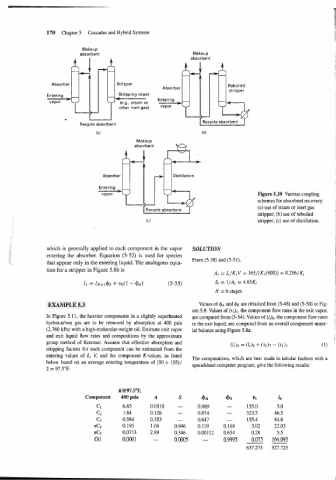
                                     vapor                                                  Figure 5.10  Various coupling
                                                    .                                       schemes for absorbent recovery:
                                                    f
                                                     Recycle absorbent                      (a) use of steam or inert gas
                                                                                            stripper; (b) use of reboiled
                                                                                            stripper; (c) use of distillation.


                  which is generally applied to each component in the vapor   SOLUTION
                  entering the  absorber. Equation (5-52) is used  for species
                                                                     From (5-38) and (5-51),
                  that appear only in the entering liquid. The analogous equa-
                  tion for a stripper in Figure 5.8b is
                                                                             Ai = L/Ki V  = 165/[Ki(800)] = 0.206/K1
                               11 = ~N+I$S + vo(1 - $A)      (5-55)          Si = 1/A;  = 4.85Ki
                                                                             N = 6 stages

                                                                        Values of $A  and   are obtained from (5-48) and (5-50) or Fig-
                                                                     ure 5.9. Values of (v,),, the component flow rates in the exit vapor,
                  In Figure  5.11, the heavier components  in a slightly superheated   are computed from (5-54). Values of   the component flow rates  1
                  hydrocarbon  gas  are  to  be  removed  by  absorption  at  400  psia   in the exit liquid, are computed from an overall component mater-   !
                  (2,760 kPa) with a high-molecular-weight oil. Estimate exit vapor   ial balance using Figure 5.8a:
                  and exit  liquid  flow  rates  and compositions  by  the  approximate
                                                                                                                       i
                  group method of  Kremser. Assume  that  effective absorption  and
                                                                                   (1116 = (&)o + (21117  - (vi)1   (1)
                  stripping  factors  for each  component can be  estimated  from  the
                  entering values  of  L,  V,  and the  component K-values,  as  listed
                                                                     The computations, which are best made in tabular fashion with a
                  below  based  on  an average entering  temperature  of  (90 + 105)/
                                                                     spreadsheet computer program, give the following results:
                  2 = 97.5"F.

                                           K@97.S°F,
                               Component    400 psia

                                   c 1       6.65
                                   c2        1.64
                                   c3        0.584
                                  nC4        0.195
                                  nCs        0.0713
                                   Oil       0.0001

