


Page 210 - Separation process principles 2
P. 210
5.5  Membrane Cascades  175
                                                                                      -


               Feed  +I-%--         Retentate   -                                             Retentate
               -
                                              Feed
                                                                                          7
                                                                                       Stage 4
                                                                  I          Stage 3
                                                             t
                                                                   Stage 2
                                                       Stage 1          T          T          t
                          Stage 1                                                             Permeate
                        (a) One stage                              (b) Multiple stage
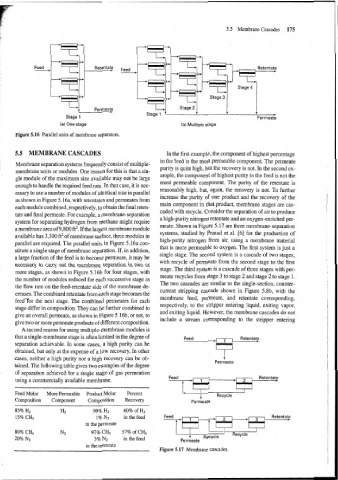
        Figure 5.16  Parallel units of membrane separators.


        5.5  MEMBRANE CASCADES                                In the first example, the component of highest percentage
                                                            in the feed is the most permeable component. The permeate
        Membrane separation systems frequently consist of multiple-
        membrane units or modules. One reason for this is that a sin-   purity is quite high, but the recovery is not. In the second ex-
                                                            ample, the component of highest purity in the feed is not the
        gle module of the maximum size available may not be large
                                                            most permeable component. The purity  of  the retentate is
        enough to handle the required feed rate. In that case, it is nec-
                                                            reasonably high, but, again, the recovery is not. To further
        essary to use a number of modules of identical size in parallel
                                                            increase the purity of  one product and the recovery of  the
        as shown in Figure 5.16a, with retentates and permeates from
                                                            main component in that product, membrane stages are cas-
        each module combined, respectively, to obtain the final reten-
                                                            caded with recycle. Consider the separation of air to produce
        tate and final permeate. For example, a membrane-separation
                                                            a high-purity nitrogen retentate and an oxygen-enriched per-
        system for separating hydrogen from methane might require
                                                            meate. Shown in Figure 5.17 are three membrane-separation
        amembrane area of 9,800 ft2. If the largest membrane module
        available has 3,300 ft2 of membrane surface, three modules in   systems, studied by  Prasad et al. [6] for the production of
                                                            high-purity nitrogen from air, using  a membrane material
        parallel are required. The parallel units in Figure 5.16a con-
                                                            that is more permeable to oxygen. The first system is just a
        stitute a single stage of membrane separation. If, in addition,
                                                            single stage. The second system is a cascade of two stages,
        a large fraction of the feed is to become permeate, it may be
                                                            with recycle of permeate from the second stage to the first
        necessary to carry out the membrane separation in two or
                                                            stage. The third system is a cascade of three stages with per-
        more stages, as shown in Figure 5.16b for four stages, with
                                                           meate recycles from stage 3 to stage 2 and stage 2 to stage 1.
        the number of modules reduced for each successive stage as
                                                            The two cascades are similar to the single-section, counter-
        the flow rate on the feed-retentate side of the membrane de-
                                                            current  stripping cascade shown in  Figure 5.8b,  with the
        creases. The combined retentate from each stage becomes the
        feedl'ror the next stage. The combined permeates for each   membrane  feed,  permeate,  and  retentate  corresponding,
                                                           respectively, to  the  stripper entering liquid, exiting vapor,
        stage differ in composition. They can be further combined to
                                                            and exiting liquid. However, the membrane cascades do not
        give an overall permeate, as shown in Figure 5.16b, or not, to
                                                           include  a  stream  corresponding  to  the  stripper  entering
        give two or more permeate products of different composition.
          A second reason for using multiple-membrane modules is
        that a single-membrane stage is often limited in the degree of                  Retentate
        separation achievable. In some cases, a high purity can be
        obtained, but only at the expense of a low recovery. In other
        cases, neither a high purity nor a high recovery can be ob-  P- Permeate
        tained. The following table gives two examples of the degree
        of  separation achieved for a single stage of gas permeation
        using a commercially available membrane.
        Feed Molar   More Permeable  Pro'duct Molar   Percent             +     Recycle
        Composition   Component   Composition   Recovery               Permeate
        85%  H2         H2          99% H2     60% of H2
        15% CH4                      1% N2     in the feed
                                 in the permeate
                                                                             1
        80% CH4         N2         97% C&     57% of C&          -         Recycle   Recycle  '
        20% N2                      3% N2      in the feed         Permeate
                                 in the retentate
                                                           Figure 5.17  Membrane cascades.

