


Page 213 - Separation process principles 2
P. 213
178  Chapter 5  Cascades and Hybrid Systems


                  This approach to separation process design was developed
                  by Kwauk [8], and a modification of his methodology forms
                  the basis for this discussion.
                     Typically, the variables in a separation process are inten-           Equilibrium stage
                  sive variables such as composition, temperature, and pres-
                  sure; extensive variables such as flow rate or the heat-transfer  .I=: L~~~        '1 N
                  rate; and equipment parameters such as the number of equi-
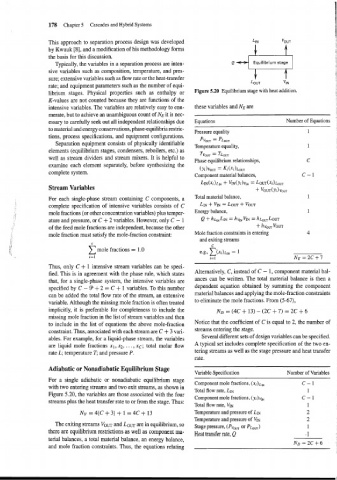
                  librium  stages.  Physical  properties  such  as  enthalpy  or   Figure 5.20  Equilibrium stage with heat addition.
                  K-values are not counted because they are functions of  the
                  intensive variables. The variables are relatively easy to enu-   these variables and NE are
                  merate, but to achieve an unambiguous count of NE it is nec-
                  essary to carefully seek out all independent relationships due   Equations          Number of Equations
                  to material and energy conservations, phase-equilibria restric-   Pressure equality         1
                  tions, process specifications, and equipment configurations.
                                                                        Pvom = PLOUT
                     Separation equipment consists of physically identifiable   equality,                     1
                  elements (equilibrium stages, condensers, reboilers, etc.) as
                                                                        Tvow = TLOW
                  well as stream dividers and stream mixers. It is helpful to
                                                                      Phase equilibrium relationships,        C
                  examine each  element separately, before synthesizing the
                                                                        ( Y I ) v ~ ~ = KI(XL)LOUT
                  complete system.                                    Component material balances,
                                                                                                            C-1
                                                                        LIN(x~)LIN + VIN(Y~)V~~ Lo~(xi)~ouT
                                                                                          =
                   Stream Variables
                                                                                           + VOUT(Y~) VOUT
                  For each  single-phase stream containing  C components, a   Total material balance,         1
                   complete specification of  intensive variables consists of  C   LIN  + VIN  = LOUT + VOUT
                   mole fractions (or other concentration variables) plus temper-   Energy balance,           1
                                                                                  =
                   ature and pressure, or C + 2 variables. However, only C - 1   Q + ~L~NLIN hvIN VIN = ~L~~LOUT
                   of the feed mole fractions are independent, because the other            + h vow VOUT
                  mole fraction must satisfy the mole-fraction constraint:   Mole fraction constraints in entering   4
                                                                        and exiting streams
                                                                            r
                                    mole fractions = 1.0
                                 i=l
                  Thus, only C + 1 intensive stream variables can be  speci-
                   fied. This is in agreement with   phase rule,   states   Alternatively, C, instead of C - 1, component material bal-
                   that, for a single-phase system, the intensive variables are   ances can be written. The total material balance is then a
                   specified by c - g + 2 = c + 1 variables. T~ this number   dependent equation obtained  by  summing the component
                  can be added the total flow rate of the stream, an extensive   material balances and applying the mole-fraction constraints
                   variable. Although the missing mole fraction is often treated   to   the         (5-67)7
                  implicitly, it is preferable for completeness to include the   ND=(4C+13)-(2C+7)=2C+6
                  missing mole fraction in the list of stream variables and then
                                                                      Notice that the coefficient of C is equal to 2, the number of
                  to include in the list of  equations the above mole-fraction
                  constraint. Thus, associated with each stream are C + 3 vari-   streams entering the stage.
                  ables. For example, for a liquid-phase stream, the variables   Several different sets of design variables can be specified.
                   are liquid  mole  fractions XI, x2, . . . , xc; total molar flow   A typical set includes complete specification of the two en-
                  rate L; temperature T; and pressure P.              tering streams as well as the stage pressure and heat transfer
                                                                      rate.
                  Adiabatic or Nonadiabatic Equilibrium Stage
                                                                      Variable Specification           Number of Variables
                  For  a  single  adiabatic  or  nonadiabatic  equilibrium  stage
                                                                      Component mole fractions, (xi)L1,
                  with two entering streams and two exit streams, as shown in
                                                                      Total flow rate, LIN
                  Figure 5.20, the variables are those associated with the four
                                                                      Component mole fractions, (yi)vw
                  streams plus the heat transfer rate to or from the stage. Thus:
                                                                      Total flow rate, Vm
                                                                      Temperature and pressure of Lm
                                                                      Temperature and pressure of Vm
                     The exiting streams VOUT and LoL1~ are in equilibrium, so   Stage pressure, (PvouT or PLOW)
                  there are equilibrium restrictions as well as component ma-
                                                                      Heat transfer rate, Q
                  terial balances, a total material balance, an energy balance,
                  and mole fraction constraints. Thus, the equations relating

