


Page 211 - Separation process principles 2
P. 211
176  Chapter 5  Cascades and Hybrid Systems


                 vapor. Not  shown in Figure 5.17 are recycle gas compres-
                 sors. Typical calculations of Prasad et al. [6] give the fol-
                 lowing results:                                                         1
                                                                                                   Permeate
                        Membrane        Mol% N2     % Recovery                         (a) Membrane alone
                         System        in Retentate    of N2                                       Adsorbate
                                                                                                    CH,-rich
                     Single stage         98            45
                     Two-stage cascade    99.5          48
                                                                                         I        I
                     Three-stage cascade   99.9         50                                          Exhaust
                 These results show that a high purity can be obtained with           (b) Adsorption alone
                 a single-section membrane cascade, but without major im-
                 provement in the recovery. To obtain both high purity and
                 high recovery, a  two-section  membrane cascade is neces-     r
                 sary, as discussed in Section 14.3.                              Recycle


                 5.6  HYBRID SYSTEMS
                                                                                             I   N,-rich
                 To reduce costs, particularly energy cost, make possible a              I           t
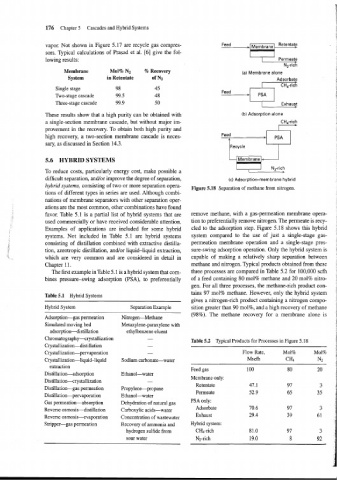
                 difficult separation, andlor improve the degree of separation,   (c) Adsorption-membrane  hybrid
                 hybrid systems, consisting of two or more separation opera-
                                                                     Figure 5.18  Separation of methane from nitrogen.
                 tions of different types in series are used. Although combi-
                 nations of membrane separators with other separation oper-
                 ations are the most common, other combinations have found
                 favor. Table 5.1 is a partial list of hybrid systems that are   remove methane, with a gas-permeation membrane opera-
                 used commercially or have received considerable attention.   tion to preferentially remove nitrogen. The permeate is recy-
                 Examples  of  applications  are  included  for  some  hybrid   cled to the adsorption step. Figure 5.18 shows this hybrid
                 systems.  Not  included  in  Table  5.1  are  hybrid  systems   system  compared  to  the  use  of  just  a  single-stage  gas-
                 consisting of distillation combined with extractive distilla-   permeation  membrane operation  and  a  single-stage pres-
                 tion, azeotropic distillation, andlor liquid-liquid  extraction,   sure-swing adsorption operation. Only the hybrid system is
                 which  are  very  common  and  are  considered in  detail  in   capable of  making  a  relatively  sharp  separation between
                 Chapter 11.                                         methane and nitrogen. Typical products obtained from these
                    The first example in Table 5.1 is a hybrid system that com-   three processes are compared in Table 5.2 for 100,000 scfh
                 bines  pressure-swing  adsorption  (PSA),  to  preferentially   of a feed containing 80 mol% methane and 20 mol% nitro-
                                                                     gen. For all three processes, the methane-rich product con-
                                                                     tains 97 mol% methane. However, only the hybrid system
                 Table 5.1  Hybrid Systems
                                                                     gives a nitrogen-rich product containing a nitrogen compo-
                 Hybrid System                 Separation Example    sition greater than 90 mol%, and a high recovery of methane
                                                                     (98%). The  methane  recovery  for  a  membrane  alone  is
                 Adsorption-gas  permeation   Nitrogen-Methane
                 Simulated moving bed       Metaxylene-parax ylene with
                   adsorption-distillation    ethylbenzene eluent
                 Chromatography-crystallization      -
                                                                     Table 5.2  Typical Products for Processes in Figure 5.18
                 Crystallization-distillation        -
                 Crystallization-pervaporation       -                                 Flow Rate,    Mol%       Mol%
                 Crystallization-liquid-liquid   Sodium carbonate-water                 Mscfh         CH4        Nz
                   extraction
                                                                    Feed gas            100           80         20
                 Distillation-adsorption    Ethanol-water
                                                                    Membrane only:
                 Distillation-crystallization        -
                                                                      Retentate          47.1         97          3
                 Distillation-gas  permeation   Propy lene-propane
                                                                      Permeate           52.9         65         35
                 Distillalion-pervaporation   Ethanol-water
                                                                    PSA only:
                 Gas permeation-absorption   Dehydration of natural gas
                 Reverse osmosis4istillation   Carboxylic acids-water   Adsorbate        70.6         97          3
                 Reverse osmosis-evaporation   Concentration of wastewater   Exhaust     29.4         39         61
                 Stripper-gas  permeation   Recovery of ammonia and   Hybrid system:
                                              hydrogen sulfide from   CH4-rich           81.0         97          3
                                              sour water              Nz-rich            19.0          8         92

