


Page 551 - Shigley's Mechanical Engineering Design
P. 551
bud29281_ch10_517-568.qxd  12/16/2009  7:14 pm  Page 525 pinnacle 203:MHDQ196:bud29281:0073529281:bud29281_pagefiles:


                                                                                                Mechanical Springs  525
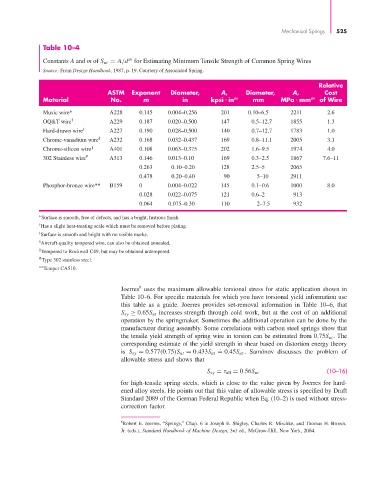
                       Table 10–4

                       Constants A and m of S ut = A/d for Estimating Minimum Tensile Strength of Common Spring Wires
                                                 m
                       Source: From Design Handbook, 1987, p. 19. Courtesy of Associated Spring.

                                                                                                            Relative
                                           ASTM   Exponent    Diameter,       A,     Diameter,      A,       Cost
                       Material             No.       m           in      kpsi   in m  mm       MPa   mm m  of Wire

                       Music wire*         A228     0.145    0.004–0.256      201     0.10–6.5     2211       2.6
                       OQ&T wire †         A229     0.187    0.020–0.500      147      0.5–12.7    1855       1.3
                       Hard-drawn wire ‡   A227     0.190    0.028–0.500      140      0.7–12.7    1783       1.0
                       Chrome-vanadium wire §  A232  0.168   0.032–0.437      169      0.8–11.1    2005       3.1
                       Chrome-silicon wire     A401  0.108   0.063–0.375      202      1.6–9.5     1974       4.0
                       302 Stainless wire #  A313   0.146    0.013–0.10       169      0.3–2.5     1867      7.6–11
                                                    0.263     0.10–0.20       128      2.5–5       2065
                                                    0.478     0.20–0.40       90         5–10      2911
                       Phosphor-bronze wire**  B159  0       0.004–0.022      145      0.1–0.6     1000       8.0
                                                    0.028    0.022–0.075      121      0.6–2        913
                                                    0.064    0.075–0.30       110        2–7.5      932

                      Surface is smooth, free of defects, and has a bright, lustrous finish.
                      ∗
                      † Has a slight heat-treating scale which must be removed before plating.
                      ‡ Surface is smooth and bright with no visible marks.
                      § Aircraft-quality tempered wire, can also be obtained annealed.
                      Tempered to Rockwell C49, but may be obtained untempered.

                      # Type 302 stainless steel.
                       Temper CA510.
                      ∗∗

                                                    8
                                               Joerres uses the maximum allowable torsional stress for static application shown in
                                               Table 10–6. For specific materials for which you have torsional yield information use
                                               this table as a guide. Joerres provides set-removal information in  Table 10–6, that
                                               S sy ≥ 0.65S ut increases strength through cold work, but at the cost of an additional
                                               operation by the springmaker. Sometimes the additional operation can be done by the
                                               manufacturer during assembly. Some correlations with carbon steel springs show that
                                               the tensile yield strength of spring wire in torsion can be estimated from 0.75S ut . The
                                               corresponding estimate of the yield strength in shear based on distortion energy theory
                                                                             .
                                               is  S sy = 0.577(0.75)S ut = 0.433S ut = 0.45S ut . Samónov discusses the problem of
                                               allowable stress and shows that
                                                                                                              (10–16)
                                                                         S sy = τ all = 0.56S ut
                                               for high-tensile spring steels, which is close to the value given by Joerres for hard-
                                               ened alloy steels. He points out that this value of allowable stress is specified by Draft
                                               Standard 2089 of the German Federal Republic when Eq. (10–2) is used without stress-
                                               correction factor.

                                               8 Robert E. Joerres, “Springs,” Chap. 6 in Joseph E. Shigley, Charles R. Mischke, and Thomas H. Brown,
                                               Jr. (eds.), Standard Handbook of Machine Design, 3rd ed., McGraw-Hill, New York, 2004.

