


Page 548 - Shigley's Mechanical Engineering Design
P. 548
bud29281_ch10_517-568.qxd  12/16/2009  7:14 pm  Page 522 pinnacle 203:MHDQ196:bud29281:0073529281:bud29281_pagefiles:


                 522   Mechanical Engineering Design
                                10–5      Stability

                                          In Chap. 4 we learned that a column will buckle when the load becomes too large.
                                          Similarly, compression coil springs may buckle when the deflection becomes too
                                          large. The critical deflection is given by the equation


                                                                                       1/2
                                                                                  C 2
                                                               y cr = L 0 C 1    1 − 1 −  2              (10–10)
                                                                                  λ eff
                                                                                                       5
                                          where y cr is the deflection corresponding to the onset of instability. Samónov states that
                                                                                                    7
                                                                  6
                                          this equation is cited by Wahl and verified experimentally by Haringx. The quantity
                                          λ eff in Eq. (10–10) is the effective slenderness ratio and is given by the equation
                                                                             αL 0
                                                                        λ eff =                          (10–11)
                                                                               D
                                          C and C are elastic constants defined by the equations


                                                  2
                                           1
                                                                              E

                                                                     C =
                                                                       1
                                                                          2(E − G)
                                                                             2
                                                                          2π (E − G)

                                                                     C =
                                                                       2
                                                                            2G + E
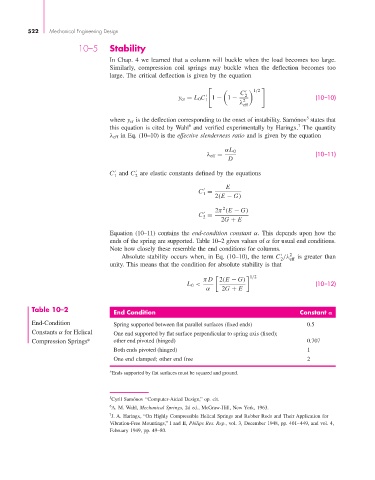
                                          Equation (10–11) contains the  end-condition constant α. This depends upon how the
                                          ends of the spring are supported. Table 10–2 gives values of α for usual end conditions.
                                          Note how closely these resemble the end conditions for columns.

                                              Absolute stability occurs when, in Eq. (10–10), the term C /λ 2 eff  is greater than
                                                                                               2
                                          unity. This means that the condition for absolute stability is that
                                                                                      1/2
                                                                       π D 2(E − G)
                                                                  L 0 <                                  (10–12)
                                                                        α    2G + E
                  Table 10–2
                                           End Condition                                             Constant
                  End-Condition            Spring supported between flat parallel surfaces (fixed ends)  0.5
                  Constants α for Helical  One end supported by flat surface perpendicular to spring axis (fixed);
                  Compression Springs*     other end pivoted (hinged)                                  0.707
                                           Both ends pivoted (hinged)                                  1
                                           One end clamped; other end free                             2

                                           Ends supported by flat surfaces must be squared and ground.
                                          ∗


                                          5 Cyril Samónov “Computer-Aided Design,” op. cit.
                                          6 A. M. Wahl, Mechanical Springs, 2d ed., McGraw-Hill, New York, 1963.
                                          7 J. A. Haringx, “On Highly Compressible Helical Springs and Rubber Rods and Their Application for
                                          Vibration-Free Mountings,” I and II, Philips Res. Rep., vol. 3, December 1948, pp. 401–449, and vol. 4,
                                          February 1949, pp. 49–80.

