


Page 547 - Shigley's Mechanical Engineering Design
P. 547
bud29281_ch10_517-568.qxd  12/16/2009  7:14 pm  Page 521 pinnacle 203:MHDQ196:bud29281:0073529281:bud29281_pagefiles:


                                                                                                Mechanical Springs  521
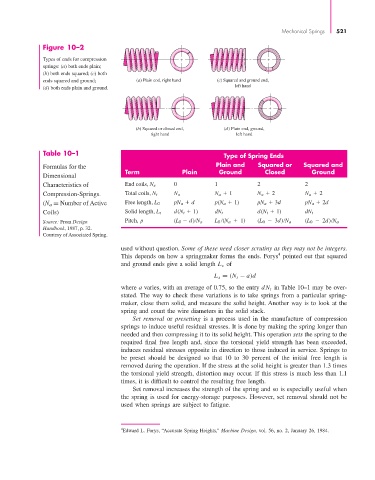
                       Figure 10–2

                       Types of ends for compression             +                          +
                       springs: (a) both ends plain;
                       (b) both ends squared; (c) both
                       ends squared and ground;     (a) Plain end, right hand  (c) Squared and ground end,
                       (d) both ends plain and ground.                            left hand


                                                                  +                         +


                                                   (b) Squared or closed end,  (d) Plain end, ground,
                                                        right hand                left hand


                       Table 10–1                                             Type of Spring Ends
                       Formulas for the                                     Plain and    Squared or    Squared and
                                                Term              Plain      Ground        Closed         Ground
                       Dimensional
                       Characteristics of       End coils, N e  0           1            2             2
                       Compression-Springs.     Total coils, N t  N a       N a   1      N a   2       N a   2
                       (N a = Number of Active  Free length, L 0  pN a   d  p(N a   1)   pN a   3d     pN a   2d
                       Coils)                   Solid length, L s  d(N t   1)  dN t      d(N t   1)    dN t
                       Source: From Design      Pitch, p       (L 0   d) N a  L 0  (N a   1)  (L 0   3d) N a  (L 0   2d) N a
                       Handbook, 1987, p. 32.
                       Courtesy of Associated Spring.

                                               used without question. Some of these need closer scrutiny as they may not be integers.
                                                                                               4
                                               This depends on how a springmaker forms the ends. Forys pointed out that squared
                                               and ground ends give a solid length L s of
                                                                            L s = (N t − a)d
                                               where a varies, with an average of 0.75, so the entry dN t in Table 10–1 may be over-
                                               stated. The way to check these variations is to take springs from a particular spring-
                                               maker, close them solid, and measure the solid height. Another way is to look at the
                                               spring and count the wire diameters in the solid stack.
                                                  Set removal or presetting is a process used in the manufacture of compression
                                               springs to induce useful residual stresses. It is done by making the spring longer than
                                               needed and then compressing it to its solid height. This operation sets the spring to the
                                               required final free length and, since the torsional yield strength has been exceeded,
                                               induces residual stresses opposite in direction to those induced in service. Springs to
                                               be preset should be designed so that 10 to 30 percent of the initial free length is
                                               removed during the operation. If the stress at the solid height is greater than 1.3 times
                                               the torsional yield strength, distortion may occur. If this stress is much less than 1.1
                                               times, it is difficult to control the resulting free length.
                                                  Set removal increases the strength of the spring and so is especially useful when
                                               the spring is used for energy-storage purposes. However, set removal should not be
                                               used when springs are subject to fatigue.


                                               4 Edward L. Forys, “Accurate Spring Heights,” Machine Design, vol. 56, no. 2, January 26, 1984.

