


Page 130 - Silence in Intercultural Communication
P. 130
Chapter 5.  Performance and perceptions of silence  117


                     A:     Because of the lack of preparation, pretty difficult reading and my
                             English competence, I mean the fact that I am not used to this kind
                             of reading, it is quite hard for me to express myself.

             Her lack of language to handle academic concepts in history and education, espe-
             cially in the Australian context, is likely to have prevented her from participating
             as actively as she would have done in other contexts (see Section 5.4.5 below). As a
             matter of fact, there were a few incidents which suggested that Aya was not able to
             keep up with the subject in terms of her academic English. The following excerpt
             gives one such example:

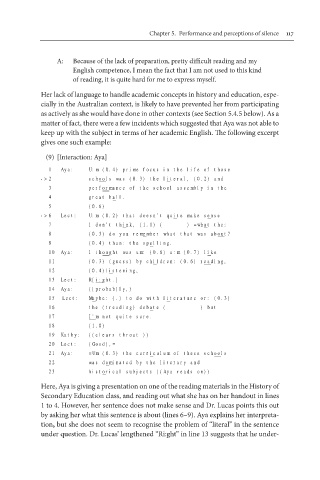
               (9)  [Interaction: Aya]

             	 	1			Aya:				U:m	(0.4)	prime	focus	in	the	life	of	those
             ->	2										schools	was	(0.3)	the	literal,	(0.2)	and
             	 	3										performance	of	the	school	assembly	in	the
             	 	4										great	hall.
             	 	5										(0.6)
             ->	6			Lect:			U:m	(0.2)	that	doesn’t	quite	make	sense
             	 	7										I	don’t	think,	(1.1)	(							)	=what	the:
             	 	8										(0.3)	do	you	remember	what	that	was	about?
             	 	9										(0.4)	than:	the	spelling.
             	 	10		Aya:				I	thought	was	um:	(0.6)	u:m	(0.7)	like
             	 	11									(0.3)	(guess)	by	children:	(0.6)	reading,
             	 	12									(0.4)listening,
             	 	13		Lect:			R[i:ght.]
             	 	14		Aya:				([probab]ly,)
             	 	15		Lect:			Maybe:	(.)	to	do	with	literature	or:	(0.3)
             	 	16									the	(treading)	debate	(										)	but
             	 	17									I’m	not	quite	sure.
             	 	18									(1.0)
             	 	19		Kathy:		((clears	throat	))
             	 	20		Lect:			(Good),=
             	 	21		Aya:				=Um	(0.3)	the	curriculum	of	these	schools
             	 	22									was	dominated	by	the	literary	and
             	 	23									historical	subjects	((Aya	reads	on))

             Here, Aya is giving a presentation on one of the reading materials in the History of
             Secondary Education class, and reading out what she has on her handout in lines
             1 to 4. However, her sentence does not make sense and Dr. Lucas points this out
             by asking her what this sentence is about (lines 6–9). Aya explains her interpreta-
             tion, but she does not seem to recognise the problem of “literal” in the sentence
             under question. Dr. Lucas’ lengthened “Ri:ght” in line 13 suggests that he under-

