


Page 133 - Silence in Intercultural Communication
P. 133
120  Silence in Intercultural Communication


                20  Tamara:   =Mm ↑hm.
             	 	21		Lect:				The	bell	curves?	(1.0)	so	I	can	only	get
             	 	22										uh	certain	number	between	ninety	in	a
             	 	23										hundred,=
             	 	24		Tadashi:		=Mm:.=
             	 	25		Lect:				=and	eighty	in	a	hundred.
             	 	26		Tadashi:		Mm:.
             ->	27										(0.5)
             ->	 28		Tadashi:		Yes	in	a	(0.4)	standard	(.)	or	criteria
             	 	29										referencing,	.hhh	u:m	as	long	as	the	students
             	 	30										performs	well,	(0.2)	you	can	(.)	you	can
             	 	31										have	as	many	(0.2)	students	as	possible	(0.5)
             	 	32										in	say	(0.3)	between	ninety	to	one	hundred.
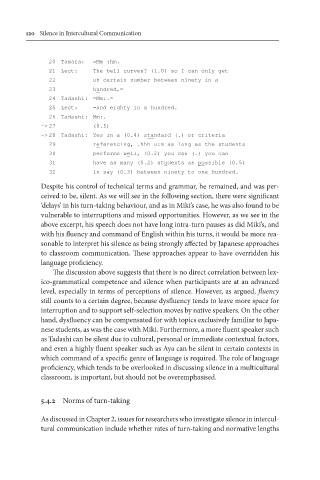
             Despite his control of technical terms and grammar, he remained, and was per-
             ceived to be, silent. As we will see in the following section, there were significant
             ‘delays’ in his turn-taking behaviour, and as in Miki’s case, he was also found to be
             vulnerable to interruptions and missed opportunities. However, as we see in the
             above excerpt, his speech does not have long intra-turn pauses as did Miki’s, and
             with his fluency and command of English within his turns, it would be more rea-
             sonable to interpret his silence as being strongly affected by Japanese approaches
             to classroom communication. These approaches appear to have overridden his
             language proficiency.
                The discussion above suggests that there is no direct correlation between lex-
             ico-grammatical competence and silence when participants are at an advanced
             level, especially in terms of perceptions of silence. However, as argued, fluency
             still counts to a certain degree, because dysfluency tends to leave more space for
             interruption and to support self-selection moves by native speakers. On the other
             hand, dysfluency can be compensated for with topics exclusively familiar to Japa-
             nese students, as was the case with Miki. Furthermore, a more fluent speaker such
             as Tadashi can be silent due to cultural, personal or immediate contextual factors,
             and even a highly fluent speaker such as Aya can be silent in certain contexts in
             which command of a specific genre of language is required. The role of language
             proficiency, which tends to be overlooked in discussing silence in a multicultural
             classroom, is important, but should not be overemphasised.


             5.4.2  Norms of turn-taking

             As discussed in Chapter 2, issues for researchers who investigate silence in intercul-
             tural communication include whether rates of turn-taking and normative lengths

