


Page 136 - Silence in Intercultural Communication
P. 136
Chapter 5.  Performance and perceptions of silence  123


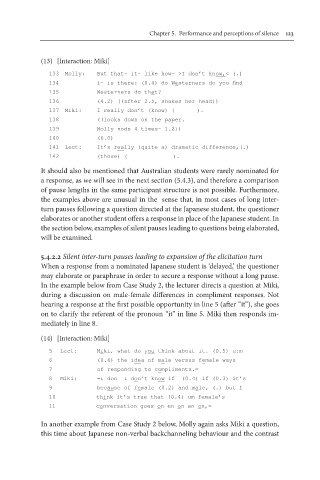
             (13)   [Interaction: Miki]

             	 	133		Molly:			But	that-	it-	like	how-	>I	don’t	know,<	(.)
             	 	134										i-	is	there:	(0.4)	do	Westerners do you find
             	 	135										Westerners	do	that?
             	 	136										(4.2)	((after	2.5,	shakes	her	head))
             	 	137		Miki:				I	really	don’t	(know)	(						).
             	 	138										((looks	down	on	the	paper.
             	 	139										Molly	nods	4	times-	1.2))
             	 	140										(6.0)
             	 	141		Lect:				It’s	really	(quite	a)	dramatic	difference,(.)
             	 	142										(those)	(												).
             It should also be mentioned that Australian students were rarely nominated for
             a response, as we will see in the next section (5.4.3), and therefore a comparison
             of pause lengths in the same participant structure is not possible. Furthermore,
             the examples above are unusual in the  sense that, in most cases of long inter-
             turn pauses following a question directed at the Japanese student, the questioner
             elaborates or another student offers a response in place of the Japanese student. In
             the section below, examples of silent pauses leading to questions being elaborated,
             will be examined.

             5.4.2.2 Silent inter-turn pauses leading to expansion of the elicitation turn
             When a response from a nominated Japanese student is ‘delayed,’ the questioner
             may elaborate or paraphrase in order to secure a response without a long pause.
             In the example below from Case Study 2, the lecturer directs a question at Miki,
             during a discussion on male-female differences in compliment responses. Not
             hearing a response at the first possible opportunity in line 5 (after “it”), she goes
             on to clarify the referent of the pronoun “it” in line 5. Miki then responds im-
             mediately in line 8.

             (14)   [Interaction: Miki]

             	 	5			Lect:					Miki,	what	do	you	think	about	it.	(0.5)	u:m
             	 	6												(0.6)	the	idea	of	male	versus	female	ways
             	 	7												of	responding	to	compliments.=
             	 	8			Miki:					=I	don-	I	don’t	know	if-	(0.4)	if	(0.3)	it’s
             	 	9												because	of	female	(0.2)	and	male,	(.)	but	I
             	 	10											think	it’s	true	that	(0.4)	um	female’s
             	 	11											conversation	goes	on	en	on	en	on,=
             In another example from Case Study 2 below, Molly again asks Miki a question,
             this time about Japanese non-verbal backchanneling behaviour and the contrast

