


Page 132 - Silence in Intercultural Communication
P. 132
Chapter 5.  Performance and perceptions of silence  119


             	 	32		Miki:			So	(0.4)	the	(1.0)	interviewer,	(0.2)
             	 	33									came	to	her	(0.2)	family,	and	a:sked
             	 	34									(0.2)	why	(.)	why,	like	that-	that	was	a
             	 	35									program.
             	 	36									(0.2)
             	 	37		Bill:			[Mm.]
             	 	38		Miki:			[The]n	uh	they	wanted	to	kno:w	why	the
             	 	39									girl	was	behaving	like	that,(.)	and
             	 	40									mother-	mother	(1.2)	sho-	she	said
             	 	41									mother	said	she	was	trying	to	(0.5)
             	 	42									scold	her,
             	 	43		Molly:		[scold],
             	 	44		Miki:			[	so		]
             	 	45			?:					Mm	huh,=
             	 	46		Miki:			=	and	uh	but	(0.2)she	does	because:
             	 	47									the	girl	doesn't	listen	to	her,	she
             	 	48									stopped.
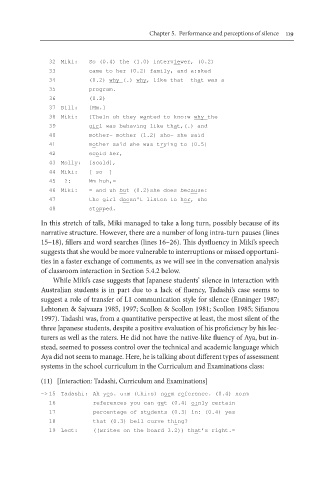
             In this stretch of talk, Miki managed to take a long turn, possibly because of its
             narrative structure. However, there are a number of long intra-turn pauses (lines
             15–18), fillers and word searches (lines 16–26). This dysfluency in Miki’s speech
             suggests that she would be more vulnerable to interruptions or missed opportuni-
             ties in a faster exchange of comments, as we will see in the conversation analysis
             of classroom interaction in Section 5.4.2 below.
                While Miki’s case suggests that Japanese students’ silence in interaction with
             Australian students is in part due to a lack of fluency, Tadashi’s case seems to
             suggest a role of transfer of L1 communication style for silence (Enninger 1987;
             Lehtonen & Sajvaara 1985, 1997; Scollon & Scollon 1981; Scollon 1985; Sifianou
             1997). Tadashi was, from a quantitative perspective at least, the most silent of the
             three Japanese students, despite a positive evaluation of his proficiency by his lec-
             turers as well as the raters. He did not have the native-like fluency of Aya, but in-
             stead, seemed to possess control over the technical and academic language which
             Aya did not seem to manage. Here, he is talking about different types of assessment
             systems in the school curriculum in the Curriculum and Examinations class:

             (11)   [Interaction: Tadashi, Curriculum and Examinations]
             ->	15		Tadashi:		Ah	yes.	u:m	(thi:s)	norm	reference.	(0.4)	norm
             	 	16										references	you	can	get	(0.4)	o:nly	certain
             	 	17										percentage	of	students	(0.3)	in:	(0.4)	yes
             	 	18										that	(0.3)	bell	curve	thing?
             	 	19		Lect:				((writes	on	the	board	3.2))	that’s	right.=

