


Page 137 - Silence in Intercultural Communication
P. 137
124  Silence in Intercultural Communication


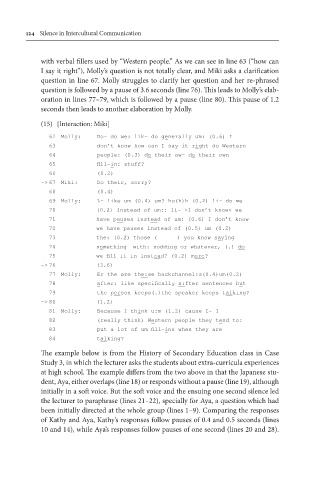
             with verbal fillers used by “Western people.” As we can see in line 63 (“how can
             I say it right”), Molly’s question is not totally clear, and Miki asks a clarification
             question in line 67. Molly struggles to clarify her question and her re-phrased
             question is followed by a pause of 3.6 seconds (line 76). This leads to Molly’s elab-
             oration in lines 77–79, which is followed by a pause (line 80). This pause of 1.2
             seconds then leads to another elaboration by Molly.

             (15)   [Interaction: Miki]

             	 	62		Molly:				Do-	do	we:	lik-	do	generally	um:	(0.6)	I
             	 	63											don’t	know	how	can	I	say	it	right	do	Western
             	 	64											people:	(0.3)	do	their	ow-	do	their	own
                65           fill-in:	stuff?
             	 	66											(0.2)
             ->	67		Miki:					Do	their,	sorry?
             	 	68											(0.4)
             	 	69		Molly:				L-	like	um	(0.4)	um?	hu(h)h	(0.2)	li-	do	we
             	 	70											(0.2)	instead	of	um::	li-	>I	don’t	know<	we
             	 	71											have	pauses	instead	of	um:	(0.6)	I	don’t	know
             	 	72											we	have	pauses	instead	of	(0.5)	um	(0.2)
             	 	73											the:	(0.2)	those	(					)	you	know	saying
             	 	74											something		with:	nodding	or	whatever,	(.)	do
                75           we fill	it	in	instead?	(0.2)	more?
             ->	76											(3.6)
             	 	77		Molly:				Er	the	are	the:se	backchannel:s(0.4)um(0.2)
             	 	78											after: like specifically a:fter	sentences	but
             	 	79											the	person	keeps(.)the	speaker	keeps	talking?
             ->	80											(1.2)
             	 	81		Molly:				Because	I	think	u:m	(1.2)	cause	I-	I
             	 	82											(really	think)	Western	people	they	tend	to:
                83           put a lot of um fill-ins	when	they	are
             	 	84											talking?
             The example below is from the History of Secondary Education class in Case
             Study 3, in which the lecturer asks the students about extra-curricula experiences
             at high school. The example differs from the two above in that the Japanese stu-
             dent, Aya, either overlaps (line 18) or responds without a pause (line 19), although
             initially in a soft voice. But the soft voice and the ensuing one second silence led
             the lecturer to paraphrase (lines 21–22), specially for Aya, a question which had
             been initially directed at the whole group (lines 1–9). Comparing the responses
             of Kathy and Aya, Kathy’s responses follow pauses of 0.4 and 0.5 seconds (lines
             10 and 14), while Aya’s responses follow pauses of one second (lines 20 and 28).

