


Page 142 - Silence in Intercultural Communication
P. 142
Chapter 5.  Performance and perceptions of silence  129


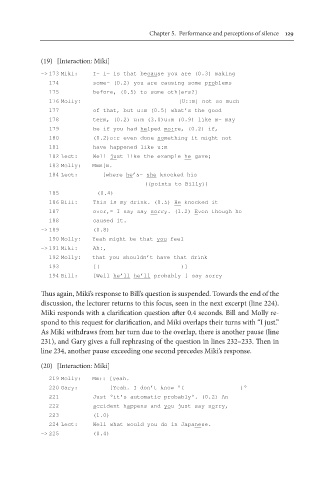
             (19)   [Interaction: Miki]

             ->	173	Miki:				I-	i-	is	that	because	you	are	(0.3)	making
             	 	174									some-	(0.2)	you	are	causing	some	problems
             	 	175									before,	(0.5)	to	some	oth[ers?]
             	 	176	Molly:																										[U::m]	not	so	much
             	 	177									of	that,	but	u:m	(0.5)	what’s	the	good
             	 	178									term,	(0.2)	u:m	(3.0)u:m	(0.9)	like	m-	may
             	 	179									be	if	you	had	helped	mo:re,	(0.2)	if,
             	 	180									(0.2)o:r	even	done	something	it	might	not
             	 	181									have	happened	like	u:m
             	 	182	Lect:				Well	just	like	the	example	he	gave;
             	 	183	Molly:			Mmm[m.
             	 	184	Lect:								[where	he’s-	she	knocked	his
             	 																									((points	to	Billy))
             	 	185										(0.4)
             	 	186	Bill:				This	is	my	drink.	(0.5)	He	knocked	it
             	 	187									over,=	I	say	say	sorry.	(1.2)	Even	though	he
             	 	188									caused	it.
             ->	189									(0.8)
             	 	190	Molly:			Yeah	might	be	that	you	feel
             ->	191	Miki:				Ah:,
             	 	192	Molly:			that	you	shouldn’t	have	that	drink
             	 	193									[(																					)]
             	 	194	Bill:				[Well	he’ll	he’ll	probably	]	say	sorry

             Thus again, Miki’s response to Bill’s question is suspended. Towards the end of the
             discussion, the lecturer returns to this focus, seen in the next excerpt (line 224).
             Miki responds with a clarification question after 0.4 seconds. Bill and Molly re-
             spond to this request for clarification, and Miki overlaps their turns with “I just.”
             As Miki withdraws from her turn due to the overlap, there is another pause (line
             231), and Gary gives a full rephrasing of the question in lines 232–233. Then in
             line 234, another pause exceeding one second precedes Miki’s response.

             (20)   [Interaction: Miki]

             	 	219	Molly:			Mm::	[yeah.
             	 	220	Gary:									[Yeah.	I	don’t	know	°(															)°
             	 	221									Just	°it's	automatic	probably°.	(0.2)	An
             	 	222									accident	happens	and	you	just	say	sorry,
             	 	223									(1.0)
             	 	224	Lect:				Well	what	would	you	do	in	Japanese.
             ->	225									(0.4)

