


Page 143 - Silence in Intercultural Communication
P. 143
130  Silence in Intercultural Communication


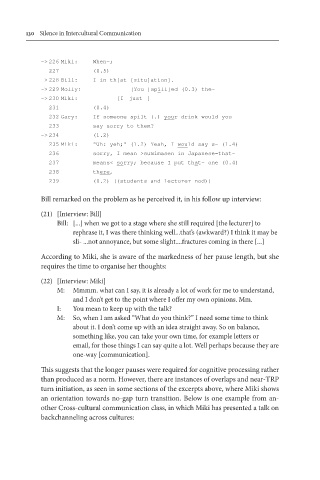
             ->	226	Miki:				When-;
             	 	227									(0.5)
             ->	228	Bill:				I-in	th[at	[situ]ation].
             ->	229	Molly:														[You	]spill]ed	(0.3)	the-
             ->	230	Miki:										[I		just			]
             	 	231									(0.4)
             	 	232	Gary:				If	someone	spilt	(.)	your	drink	would	you
             	 	233									say	sorry	to	them?
             ->	234									(1.2)
             	 	235	Miki:				°Uh:	yeh;°	(1.2)	Yeah,	I	would	say	s-	(1.4)
             	 	236									sorry,	I	mean	>sumimasen	in	Japanese=that-
             	 	237									means<	sorry;	because	I	put	that-	one	(0.4)
             	 	238									there,
             	 	239									(0.2)	((students	and	lecturer	nod))
             Bill remarked on the problem as he perceived it, in his follow up interview:

             (21)   [Interview: Bill]
                     Bill:   [...] when we got to a stage where she still required [the lecturer] to
                             rephrase it, I was there thinking well...that’s (awkward?) I think it may be
                             sli- ...not annoyance, but some slight....fractures coming in there [...]
             According to Miki, she is aware of the markedness of her pause length, but she
             requires the time to organise her thoughts:

             (22)   [Interview: Miki]
                     M:     Mmmm. what can I say, it is already a lot of work for me to understand,
                             and I don’t get to the point where I offer my own opinions. Mm.
                     I:      You mean to keep up with the talk?
                     M:     So, when I am asked “What do you think?” I need some time to think
                             about it. I don’t come up with an idea straight away. So on balance,
                             something like, you can take your own time, for example letters or
                             email, for those things I can say quite a lot. Well perhaps because they are
                             one-way [communication].
             This suggests that the longer pauses were required for cognitive processing rather
             than produced as a norm. However, there are instances of overlaps and near-TRP
             turn initiation, as seen in some sections of the excerpts above, where Miki shows
             an orientation towards no-gap turn transition. Below is one example from an-
             other Cross-cultural communication class, in which Miki has presented a talk on
             backchanneling across cultures:

