


Page 145 - Silence in Intercultural Communication
P. 145
132  Silence in Intercultural Communication


             (25)   [Interview: Bill]
                     [...] I was perceiving cultural difference here that um, yes, on one hand I
                     thought perhaps she can’t she doesn’t understand what we were saying, or
                     maybe this is (     ) just basically a language problem here, but I didn’t
                     think so. I thought, I thought it was cultural. I thought it was cultural
                     behaviour affecting linguistic behaviour. [...]

             Chapter 4 discussed comments by Japanese interviewees which referred to being
             silenced by their Australian peers. If we compare such reactions to Australian
             students’ turn-taking behaviour with the above interpretations of silence by the
             Australian lecturer and peer, it is possible to see that misunderstanding between
             Japanese and Australian students may occur. From the Japanese point of view,
             Australians are rude or aggressive, but from the Australian point of view, they are
             being helpful to the Japanese students. Miki’s silence shown above is difficult to
             interpret, as the silence could be intended as an expression of inability (thus an in-
             direct request for help), or as thinking time, to which she assumes she is entitled.
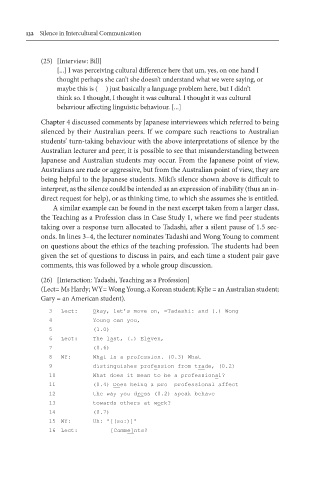
                A similar example can be found in the next excerpt taken from a larger class,
             the Teaching as a Profession class in Case Study 1, where we find peer students
             taking over a response turn allocated to Tadashi, after a silent pause of 1.5 sec-
             onds. In lines 3–4, the lecturer nominates Tadashi and Wong Young to comment
             on questions about the ethics of the teaching profession. The students had been
             given the set of questions to discuss in pairs, and each time a student pair gave
             comments, this was followed by a whole group discussion.

             (26)   [Interaction: Tadashi, Teaching as a Profession]
             (Lect= Ms Hardy; WY= Wong Young, a Korean student; Kylie = an Australian student;
             Gary = an American student).

             	 	3			Lect:				Okay,	let’s	move	on,	=Tadashi:	and	(.)	Wong
             	 	4											Young	can	you,
             	 	5											(1.0)
             	 	6			Lect:				The	last,	(.)	Eleven,
             	 	7											(0.6)
             	 	8			WY:						What	is	a	profession.	(0.3)	What
             	 	9											distinguishes	profession	from	trade,	(0.2)
             	 	10										What	does	it	mean	to	be	a	professional?
             	 	11										(0.4)	Does	being	a	pro-	professional	affect
             	 	12										the	way	you	dress	(0.2)	speak	behave
             	 	13										towards	others	at	work?
             	 	14										(0.7)
             	 	15		WY:						Uh:	°[(so:)]°
             	 	16		Lect:										[Comme]nts?

