


Page 150 - Silence in Intercultural Communication
P. 150
Chapter 5.  Performance and perceptions of silence  137


             second language, it is difficult for Japanese students to adapt to this mode of com-
             munication.
                For example, in the Teaching as a Profession class, the legal implications of
             the teachers’ drinking alcohol were discussed at one stage. Tadashi did not speak
             publicly about his own experience of seeing the teachers drinking after school
             in the teachers’ room, but he shared this experience privately with his classmate
             Peter during a heated discussion in the classroom. This was captured in the video-
             recording and confirmed in a recall interview. He indicated that he thought about
             sharing his story with the class but he didn’t, because it was difficult for him to
             find the right timing to speak.
                The timing of self-selection also emerged in Aya’s presentation in Case Study
             3.  The  presentation  in  the  History  of  Secondary  Education  class  was  on  the
             weekly reading materials, in which the student presenter explained, summarised
             and  discussed  these  materials.  In  all  student  presentations,  the  lecturer  made
             comments or asked questions from time to time. What follows is a series of ex-
             cerpts showing transition of turns, where student presenters go through questions
             prepared for tutorial discussions. In general, the students responded to questions
             and the lecturer would provide feedback. However, as the lecturer did not mark
             the end of this feedback in an explicit manner, it was left to the presenter to initi-
             ate the move onto the next question. In their role as discussion leaders, then, the
             presenters had to negotiate the transitions from one question to another. Below,
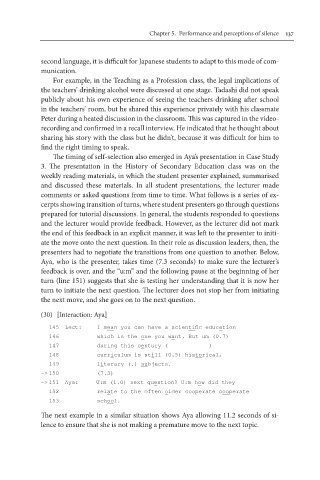
             Aya, who is the presenter, takes time (7.3 seconds) to make sure the lecturer’s
             feedback is over, and the “u:m” and the following pause at the beginning of her
             turn (line 151) suggests that she is testing her understanding that it is now her
             turn to initiate the next question. The lecturer does not stop her from initiating
             the next move, and she goes on to the next question.

             (30)   [Interaction: Aya]

             	 	145		Lect:				I	mean	you	can	have	a	scientific education
             	 	146										which	is	the	one	you	want.	But	um	(0.7)
             	 	147										during	this	century	(											)
             	 	148										curriculum	is	still	(0.5)	historical,
             	 	149										literary	(.)	subjects.
             ->	150										(7.3)
             ->	151		Aya:					U:m	(1.0)	next	question?	U:m	how	did	they
             	 	152										relate	to	the	often	older	cooperate	cooperate
             	 	153										school.
             The next example in a similar situation shows Aya allowing 11.2 seconds of si-
             lence to ensure that she is not making a premature move to the next topic.

