


Page 152 - Silence in Intercultural Communication
P. 152
Chapter 5.  Performance and perceptions of silence  139


             Here, Aya’s eye-gaze is on her sheet of paper in line 172, and as she says “and” in
             a soft voice she turns the page, getting ready for her next question. However, the
             lecturer continues to talk about the previous topic, and Aya is required to do her
             negotiating work again by waiting a few moments in line 176. While “okay” can
             signal “readiness to commence the next section of talk” (Rendle-Short 2000: 26),
             “um” and “and” signal continuity in talk. Hence, Aya's strategies are less powerful
             in terms of control over the discussion, which could lead to negative judgements
             about her “leadership” and “engagement” in tutorial discussions. According to
             Dorr-Bremme (1990), “framing words” (p. 388), which are equivalent to bound-
             ary markers, can play important roles as contextualisation cues in controlling and
             regulating classroom talk efficiently, and an absence of these “framing words”
             is likely to cause problems in “enacting authority” and “maintaining the floor”
             (p. 389). The perceptions of Aya being “quiet” and “retiring” may partly be partly
             due to the absence of these “framing words” combined with longer silences pre-
             ceding topic initiating moves in her presentation.
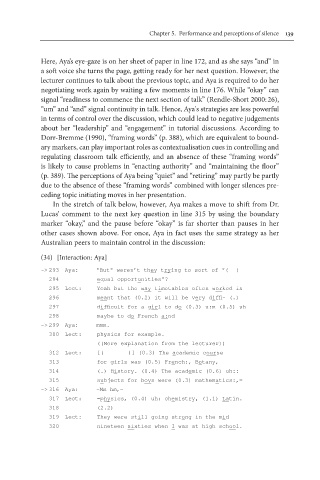
                In the stretch of talk below, however, Aya makes a move to shift from Dr.
             Lucas’ comment to the next key question in line 315 by using the boundary
             marker “okay,” and the pause before “okay” is far shorter than pauses in her
             other cases shown above. For once, Aya in fact uses the same strategy as her
             Australian peers to maintain control in the discussion:

             (34)   [Interaction: Aya]

             ->	293		Aya:					°But°	weren’t	they	trying	to	sort	of	°(			)
             	 	294										equal	opportunities°?
             	 	295		Lect:				Yeah	but	the	way	timetables	often	worked	is
             	 	296										meant	that	(0.2)	it	will	be	very	diffi- (.)
             	 	297										difficult for a girl	to	do	(0.3)	u:m	(0.5)	uh
             	 	298										maybe	to	do	French	a:nd
             ->	299		Aya:					mmm.
             	 	300		Lect:				physics	for	example.
             	 													((More	explanation	from	the	lecturer))
             	 	312		Lect:				[(							)]	(0.3)	The	academic	course
             	 	313										for	girls	was	(0.5)	French:,	Botany,
             	 	314										(.)	History.	(0.4)	The	academic	(0.6)	uh::
             	 	315										subjects	for	boys	were	(0.3)	mathematics:,=
             ->	316		Aya:					=Mm	hm,=
             	 	317		Lect:				=physics,	(0.4)	uh:	chemistry,	(1.1)	Latin.
             	 	318										(2.2)
             	 	319		Lect:				They	were	still	going	strong	in	the	mid
             	 	320										nineteen	sixties	when	I	was	at	high	school.

