


Page 147 - Silence in Intercultural Communication
P. 147
134  Silence in Intercultural Communication


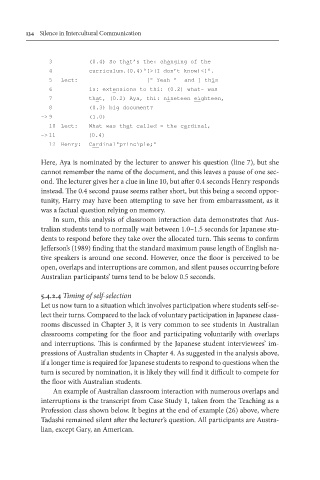
             	 	3										(0.4)	So	that’s	the:	changing	of	the
             	 	4										curriculum.(0.4)°[>(I	don’t	know)<]°.
             	 	5			Lect:																			[°	Yeah	°			and	]	this
             	 	6										is:	extensions	to	thi:	(0.2)	what-	was
             	 	7										that,	(0.2)	Aya,	thi:	nineteen	eighteen,
             	 	8										(0.3)	big	document?
             ->	9										(1.0)
             	 	10		Lect:			What	was	that	called	=	the	cardinal,
             ->	11									(0.4)
             	 	12		Henry:		Cardinal°principle;°

             Here, Aya is nominated by the lecturer to answer his question (line 7), but she
             cannot remember the name of the document, and this leaves a pause of one sec-
             ond. The lecturer gives her a clue in line 10, but after 0.4 seconds Henry responds
             instead. The 0.4 second pause seems rather short, but this being a second oppor-
             tunity, Harry may have been attempting to save her from embarrassment, as it
             was a factual question relying on memory.
                In sum, this analysis of classroom interaction data demonstrates that Aus-
             tralian students tend to normally wait between 1.0–1.5 seconds for Japanese stu-
             dents to respond before they take over the allocated turn. This seems to confirm
             Jefferson’s (1989) finding that the standard maximum pause length of English na-
             tive speakers is around one second. However, once the floor is perceived to be
             open, overlaps and interruptions are common, and silent pauses occurring before
             Australian participants’ turns tend to be below 0.5 seconds.

             5.4.2.4 Timing of self-selection
             Let us now turn to a situation which involves participation where students self-se-
             lect their turns. Compared to the lack of voluntary participation in Japanese class-
             rooms discussed in Chapter 3, it is very common to see students in Australian
             classrooms competing for the floor and participating voluntarily with overlaps
             and interruptions. This is confirmed by the Japanese student interviewees’ im-
             pressions of Australian students in Chapter 4. As suggested in the analysis above,
             if a longer time is required for Japanese students to respond to questions when the
             turn is secured by nomination, it is likely they will find it difficult to compete for
             the floor with Australian students.
                An example of Australian classroom interaction with numerous overlaps and
             interruptions is the transcript from Case Study 1, taken from the Teaching as a
             Profession class shown below. It begins at the end of example (26) above, where
             Tadashi remained silent after the lecturer’s question. All participants are Austra-
             lian, except Gary, an American.

