


Page 149 - Silence in Intercultural Communication
P. 149
136  Silence in Intercultural Communication


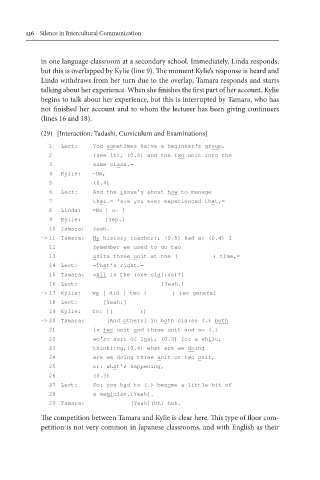
             in one language classroom at a secondary school. Immediately, Linda responds,
             but this is overlapped by Kylie (line 9). The moment Kylie’s response is heard and
             Linda withdraws from her turn due to the overlap, Tamara responds and starts
             talking about her experience. When she finishes the first part of her account, Kylie
             begins to talk about her experience, but this is interrupted by Tamara, who has
             not finished her account and to whom the lecturer has been giving continuers
             (lines 16 and 18).

             (29)   [Interaction: Tadashi, Curriculum and Examinations]

             	 	1			Lect:				You	sometimes	ha:ve	a	beginner's	group,
             	 	2											(see	it),	(0.8)	and	the	two	unit	into	the
             	 	3											same	class.=
             	 	4			Kylie:			=Um,
             	 	5											(0.4)
             	 	6			Lect:				And	the	issue's	about	how	to	manage
             	 	7											that.=	'ave	you	ever	experienced	that,=
             	 	8			Linda:			=No	[	u-	]
             	 	9			Kylie:						[Yep.]
             	 	10		Tamara:			Yeah.
             ->	11		Tamara:			My	history	teacher:,	(0.5)	had	a:	(0.4)	I
             	 	12										remember	we	used	to	do	two
             	 	13										units	three	unit	at	the	(									)	time,=
             	 	14		Lect:				=That's	right.=
             	 	15		Tamara:			=All	in	the	(one	cla[:ss)?]
             	 	16		Lect:																					[Yeah.]
             ->	17		Kylie:			We	[	did	]	two	(							)	two	general
             	 	18		Lect:									[Yeah.]
             	 	19		Kylie:			to:	[(											)]
             ->	20		Tamara:								[And	others]	in	both	cla:ss	(.)	both
             	 	21										in	two	unit	and	three	unit	and	so	(.)
             	 	22										we're	sort	of	lost,	(0.3)	for	a	while,
             	 	23										thinki:ng,(0.4)	what	are	we	doing
             	 	24										are	we	doing	three	unit	or	two	unit,
             	 	25										or:	what's	happening,
             	 	26										(0.3)
             	 	27		Lect:				So:	you	had	to	(.)	become	a	little	bit	of
             	 	28										a	magician.[Yeah].
             	 	29		Tamara:														[Yeah](hh)	huh.
             The competition between Tamara and Kylie is clear here. This type of floor com-
             petition is not very common in Japanese classrooms, and with English as their

