


Page 146 - Silence in Intercultural Communication
P. 146
Chapter 5.  Performance and perceptions of silence  133


             	 	17		WY:						U:m	(0.5)	my definition of a profession	is:
             	 	18										u:m	(0.4)	actually	(0.2)	ei	occupation,
             	 	19										(0.2)
             	 	20		Lect:				Mm	hm?
             	 	21		WY:						Uh:	but	um	(0.4)	who	got	thi:	(0.5)	um	e-
             	 	22										expert on (a special) field?
             	 	23		Lect:				Mm:	hm?=
             	 	24		WY:						=Yeah.
             	 	25										(0.4)
             ->	26		Tadashi:	An-	to	be	paid	for	(too).=
             	 	27		WY:						=Yea:h.
             	 	28		Lect:				And	what?	Sorry?
             	 	29		Tadashi:	Um	to	be	paid	for?
             	 	30										(0.3)
             	 	31		Lect:				Paid	for?=So	what	to	do	with	(distinguishing)
             	 	32										a	profession	from	a	trade.
             ->	33										(1.5)((Tadashi	looks	down,	hands	on	chin))
             	 	34		Kylie:			[You	have	to	study	to]
             	 	35		Gary:				[You	have	to	(0.2)	ni]fty	ja:rgon	(.)	if
             	 	36										you	are	a	professional	(0.2)
             	 	37										((Class	laugh))

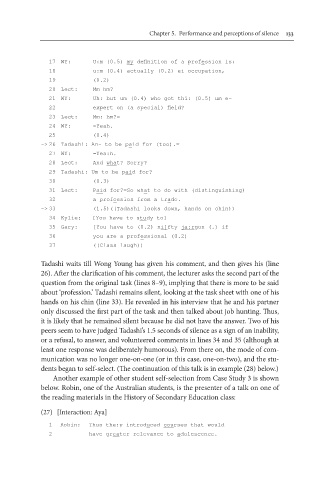
             Tadashi waits till Wong Young has given his comment, and then gives his (line
             26). After the clarification of his comment, the lecturer asks the second part of the
             question from the original task (lines 8–9), implying that there is more to be said
             about ‘profession.’ Tadashi remains silent, looking at the task sheet with one of his
             hands on his chin (line 33). He revealed in his interview that he and his partner
             only discussed the first part of the task and then talked about job hunting. Thus,
             it is likely that he remained silent because he did not have the answer. Two of his
             peers seem to have judged Tadashi’s 1.5 seconds of silence as a sign of an inability,
             or a refusal, to answer, and volunteered comments in lines 34 and 35 (although at
             least one response was deliberately humorous). From there on, the mode of com-
             munication was no longer one-on-one (or in this case, one-on-two), and the stu-
             dents began to self-select. (The continuation of this talk is in example (28) below.)
                Another example of other student self-selection from Case Study 3 is shown
             below. Robin, one of the Australian students, is the presenter of a talk on one of
             the reading materials in the History of Secondary Education class:

             (27)   [Interaction: Aya]

             	 	1			Robin:			Thus	the:y	introduced	courses	that	would
             	 	2										have	greater	relevance	to	adolescence.

