


Page 141 - Silence in Intercultural Communication
P. 141
128  Silence in Intercultural Communication


             	 	85										I’ll	apologise	and	I	say	sorry	even	if
             	 	86										that’s-	even	in	fact	it’s	not-	me	who	did
             	 	87										it.
             	 	88			?:						Mm.=
             ->	89		Bill:				=In	Japanese	is	the-	you	have	a	sorry-	w'd
             	 	90										that	be	a-	w'd	that	be	a	similar	um
             	 	91										situ[ation?]
             	 	92		Miki:									[if	:		]		if	(0.4)	you	are	not	the	one
             	 	93										who	really	caused	[it
             	 	94		Bill:																					[You	didn’t. ↑Yeah=
             	 	95		Miki:				=[Yeah.
             	 	96		Bill:				[You	didn’t	cause	it,=for	example	someone
             	 	97										might	um	(0.4)	knock	over	this.(0.4)	I-	I-
             	 	98										I	oh	sorr-	I	could	actually	say	so:rry	in
             	 	99										English.	to	them.	(0.6)	At	the	same	time
             	 	100									they’d	say	sorry.
             ->	101									(1.2)
             	 	102	Gary:				(				)	So	in	a	car	crash,	Japanese	say
             	 	103									sorry	(															)=
             	 	104	Molly:			=But	I	think	that’s	just	somebody	trying	to:
             	 	105									get	something	out	of	someone	else	who:
             	 	106									didn’	qui[te	understa:]nd.
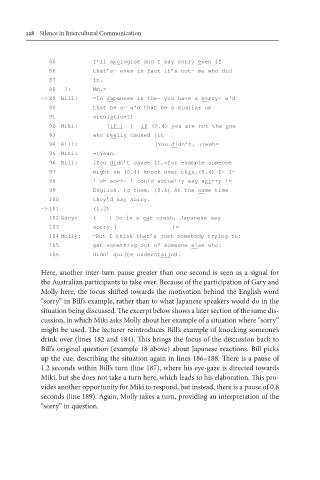
             Here, another inter-turn pause greater than one second is seen as a signal for
             the Australian participants to take over. Because of the participation of Gary and
             Molly here, the focus shifted towards the motivation behind the English word
             “sorry” in Bill’s example, rather than to what Japanese speakers would do in the
             situation being discussed. The excerpt below shows a later section of the same dis-
             cussion, in which Miki asks Molly about her example of a situation where “sorry”
             might be used. The lecturer reintroduces Bill’s example of knocking someone’s
             drink over (lines 182 and 184). This brings the focus of the discussion back to
             Bill’s original question (example 18 above) about Japanese reactions. Bill picks
             up the cue, describing the situation again in lines 186–188. There is a pause of
             1.2 seconds within Bill’s turn (line 187), where his eye-gaze is directed towards
             Miki, but she does not take a turn here, which leads to his elaboration. This pro-
             vides another opportunity for Miki to respond, but instead, there is a pause of 0.8
             seconds (line 189). Again, Molly takes a turn, providing an interpretation of the
             “sorry” in question.

