


Page 139 - Silence in Intercultural Communication
P. 139
126  Silence in Intercultural Communication


             ing an unmarked phenomenon, while one second may be felt as marked. There
             are more examples (see below) of Australian English speakers allowing 0.4–0.8
             seconds of inter-turn pauses with one another, and of the Japanese students tak-
             ing one second or more to respond, or of allowing their turns to be taken over by
             their Australian peers.
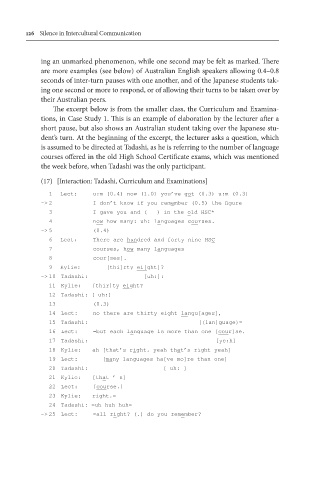
                The excerpt below is from the smaller class, the Curriculum and Examina-
             tions, in Case Study 1. This is an example of elaboration by the lecturer after a
             short pause, but also shows an Australian student taking over the Japanese stu-
             dent’s turn. At the beginning of the excerpt, the lecturer asks a question, which
             is assumed to be directed at Tadashi, as he is referring to the number of language
             courses offered in the old High School Certificate exams, which was mentioned
             the week before, when Tadashi was the only participant.

             (17)   [Interaction: Tadashi, Curriculum and Examinations]

             	 	1			Lect:				u:m	(0.4)	now	(1.0)	you’ve	got	(0.3)	u:m	(0.3)
             ->	2											I	don’t	know	if	you	remember (0.5) the figure
             	 	3											I	gave	you	and	(			)	in	the	old	HSC*
             	 	4											now	how	many:	uh:	languages	courses.
             ->	5											(0.4)
             	 	6			Lect:				There	are	hundred	and	forty	nine	HSC
             	 	7											courses,	how	many	languages
             	 	8											cour[ses].
             	 	9			Kylie:									[thi]rty	ei[ght]?
             ->	10		Tadashi:																		[uh:]:
             	 	11		Kylie:			[thir]ty	eight?
             	 	12		Tadashi:	[	uh:]
             	 	13										(0.3)
             	 	14		Lect:				no	there	are	thirty	eight	langu[ages],
             	 	15		Tadashi:																														[(lan]guage)=
             	 	16		Lect:				=but	each	language	is	more	than	one	[cour]se.
             	 	17		Tadashi:																																	[ye:h]
             	 	18		Kylie:			ah	[that’s	right.	yeah	that’s	right	yeah]
             	 	19		Lect:								[many	languages	ha[ve	mo]re	than	one]
             	 	20		Tadashi:																						[	uh:	]
             	 	21		Kylie:			[that	’	s]
             	 	22		Lect:				[course.]
             	 	23		Kylie:			right.=
             	 	24		Tadashi:	=uh	huh	huh=
             ->	25		Lect:				=all	right?	(.)	do	you	remember?

