


Page 140 - Silence in Intercultural Communication
P. 140
Chapter 5.  Performance and perceptions of silence  127


             ->	26		Tadashi:		I	don’t	remember.=	((giggling))
             	 	27		Lect:				=no?	(0.2)	okay.
                                                       * HSC = Higher School Certificate

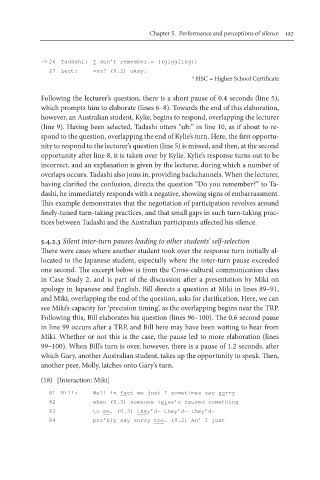
             Following the lecturer’s question, there is a short pause of 0.4 seconds (line 5),
             which prompts him to elaborate (lines 6–8). Towards the end of this elaboration,
             however, an Australian student, Kylie, begins to respond, overlapping the lecturer
             (line 9). Having been selected, Tadashi utters “uh:” in line 10, as if about to re-
             spond to the question, overlapping the end of Kylie’s turn. Here, the first opportu-
             nity to respond to the lecturer’s question (line 5) is missed, and then, at the second
             opportunity after line 8, it is taken over by Kylie. Kylie’s response turns out to be
             incorrect, and an explanation is given by the lecturer, during which a number of
             overlaps occurs. Tadashi also joins in, providing backchannels. When the lecturer,
             having clarified the confusion, directs the question “Do you remember?” to Ta-
             dashi, he immediately responds with a negative, showing signs of embarrassment.
             This example demonstrates that the negotiation of participation revolves around
             finely-tuned turn-taking practices, and that small gaps in such turn-taking prac-
             tices between Tadashi and the Australian participants affected his silence.


             5.4.2.3 Silent inter-turn pauses leading to other students’ self-selection
             There were cases where another student took over the response turn initially al-
             located to the Japanese student, especially where the inter-turn pause exceeded
             one second. The excerpt below is from the Cross-cultural communication class
             in Case Study 2, and is part of the discussion after a presentation by Miki on
             apology in Japanese and English. Bill directs a question at Miki in lines 89–91,
             and Miki, overlapping the end of the question, asks for clarification. Here, we can
             see Miki’s capacity for ‘precision timing’, as the overlapping begins near the TRP.
             Following this, Bill elaborates his question (lines 96–100). The 0.6 second pause
             in line 99 occurs after a TRP, and Bill here may have been waiting to hear from
             Miki. Whether or not this is the case, the pause led to more elaboration (lines
             99–100). When Bill’s turn is over, however, there is a pause of 1.2 seconds, after
             which Gary, another Australian student, takes up the opportunity to speak. Then,
             another peer, Molly, latches onto Gary’s turn.
             (18)   [Interaction: Miki]

             	 	81		Bill:				Well	in	fact	we	just	I	sometimes	say	sorry
                82          when (0.3) someone ↑else’s	caused	something
             	 	83										to	me,	(0.3)	they’d-	they’d-	they’d-
             	 	84										pro’bly	say	sorry	too.	(0.2)	An’	I	just

