


Page 138 - Silence in Intercultural Communication
P. 138
Chapter 5.  Performance and perceptions of silence  125


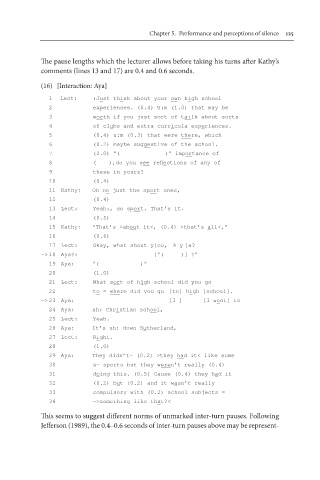
             The pause lengths which the lecturer allows before taking his turns after Kathy’s
             comments (lines 13 and 17) are 0.4 and 0.6 seconds.
             (16)   [Interaction: Aya]

                1   Lect:    ↑Just	think	about	your	own	high	school
             	 	2											experiences.	(0.4)	U:m	(1.0)	that	may	be
             	 	3											worth	if	you	just	sort	of	ta:lk	about	sorts
             	 	4											of	clubs	and	extra	curricula	experiences.
             	 	5											(0.4)	u:m	(0.3)	that	were	there,	which
             	 	6											(0.2)	maybe	suggestive	of	the	school.
             	 	7											(2.0)	°(												)°	importance	of
             	 	8											(				),do	you	see reflections	of	any	of
             	 	9											these	in	yours?
             	 	10										(0.4)
             	 	11		Kathy:			Oh	no	just	the	sport	ones,
             	 	12										(0.4)
             	 	13		Lect:				Yeah:,	so	sport.	That’s	it.
             	 	14										(0.5)
             	 	15		Kathy:			°That’s	>about	it<,	(0.4)	>that’s	all<,°
             	 	16										(0.6)
             	 	17		Lect:				Okay,	what	about	y[ou,		A	y	]a?
             ->	18		Aya?:																				[°(					)]	?°
             	 	19		Aya:					°(											)°
             	 	20										(1.0)
             	 	21		Lect:				What	sort	of	high	school	did	you	go
             	 	22										to	=	where	did	you	go			[to]	high	[school].
             ->	23		Aya:																								[I	]												[I	went]	to
             	 	24		Aya:					ah:	Christian	school,
             	 	25		Lect:				Yeah.
             	 	26		Aya:					It’s	uh:	down	Sutherland,
             	 	27		Lect:				Right.
             	 	28										(1.0)
             	 	29		Aya:					They	didn’t-	(0.2)	>they	had	it<	like	some
             	 	30										s-	sports	but	they	weren’t	really	(0.4)
             	 	31										doing	this.	(0.5)	Cause	(0.4)	they	had	it
             	 	32										(0.2)	but	(0.2)	and	it	wasn’t	really
             	 	33										compulsory	with	(0.2)	school	subjects	=
             	 	34										=>something	like	that?<
             This seems to suggest different norms of unmarked inter-turn pauses. Following
             Jefferson (1989), the 0.4–0.6 seconds of inter-turn pauses above may be represent-

