


Page 148 - Silence in Intercultural Communication
P. 148
Chapter 5.  Performance and perceptions of silence  135


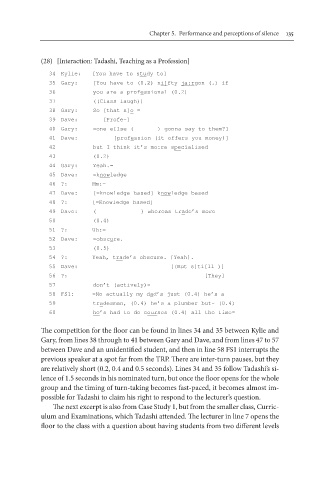
             (28)   [Interaction: Tadashi, Teaching as a Profession]

             	 	34		Kylie:			[You	have	to	study	to]
             	 	35		Gary:				[You	have	to	(0.2)	ni]fty	ja:rgon	(.)	if
             	 	36										you	are	a	professional	(0.2)
             	 	37										((Class	laugh))
             	 	38		Gary:				So	[that	n]o	=
             	 	39		Dave:									[Profe-]
             	 	40		Gary:				=one	e[lse	(							)	gonna	say	to	them?]
             	 	41		Dave:										[profession	(it	offers	you	money)]
             	 	42										but	I	think	it’s	mo:re	specialised
             	 	43										(0.2)
             	 	44		Gary:				Yeah.=
             	 	45		Dave:				=knowledge
             	 	46		?:							Mm:=
             	 	47		Dave:				[=knowledge	based]	knowledge	based
             	 	48		?:							[=Knowledge	based]
             	 	49		Dave:				(												)	whereas	trade’s	more
             	 	50										(0.4)
             	 	51		?:							Uh:=
             	 	52		Dave:				=obscure.
             	 	53										(0.5)
             	 	54		?:							Yeah,	trade’s	obscure.	[Yeah].
             	 	55		Dave:																									[(But	s]ti[ll	)]
             	 	56		?:																																							[They]
             	 	57										don’t	(actively)=
             	 	58		FS1:					=No	actually	my	dad’s	just	(0.4)	he’s	a
             	 	59										tradesman,	(0.4)	he’s	a	plumber	but-	(0.4)
             	 	60										he’s	had	to	do	courses	(0.4)	all	the	time=

             The competition for the floor can be found in lines 34 and 35 between Kylie and
             Gary, from lines 38 through to 41 between Gary and Dave, and from lines 47 to 57
             between Dave and an unidentified student, and then in line 58 FS1 interrupts the
             previous speaker at a spot far from the TRP. There are inter-turn pauses, but they
             are relatively short (0.2, 0.4 and 0.5 seconds). Lines 34 and 35 follow Tadashi’s si-
             lence of 1.5 seconds in his nominated turn, but once the floor opens for the whole
             group and the timing of turn-taking becomes fast-paced, it becomes almost im-
             possible for Tadashi to claim his right to respond to the lecturer’s question.
                The next excerpt is also from Case Study 1, but from the smaller class, Curric-
             ulum and Examinations, which Tadashi attended. The lecturer in line 7 opens the
             floor to the class with a question about having students from two different levels

