


Page 153 - Silence in Intercultural Communication
P. 153
140  Silence in Intercultural Communication


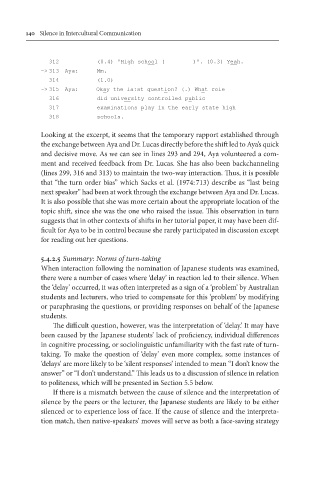
             	 	312										(0.4)	°High	school	(								)°.	(0.3)	Yeah.
             ->	313		Aya:					Mm.
             	 	314										(1.0)
             ->	315		Aya:					Okay	the	la:st	question?	(.)	What	role
             	 	316										did	university	controlled	public
             	 	317										examinations	play	in	the	early	state	high
             	 	318										schools.

             Looking at the excerpt, it seems that the temporary rapport established through
             the exchange between Aya and Dr. Lucas directly before the shift led to Aya’s quick
             and decisive move. As we can see in lines 293 and 294, Aya volunteered a com-
             ment and received feedback from Dr. Lucas. She has also been backchanneling
             (lines 299, 316 and 313) to maintain the two-way interaction. Thus, it is possible
             that “the turn order bias” which Sacks et al. (1974: 713) describe as “last being
             next speaker” had been at work through the exchange between Aya and Dr. Lucas.
             It is also possible that she was more certain about the appropriate location of the
             topic shift, since she was the one who raised the issue. This observation in turn
             suggests that in other contexts of shifts in her tutorial paper, it may have been dif-
             ficult for Aya to be in control because she rarely participated in discussion except
             for reading out her questions.

             5.4.2.5 Summary: Norms of turn-taking
             When interaction following the nomination of Japanese students was examined,
             there were a number of cases where ‘delay’ in reaction led to their silence. When
             the ‘delay’ occurred, it was often interpreted as a sign of a ‘problem’ by Australian
             students and lecturers, who tried to compensate for this ‘problem’ by modifying
             or paraphrasing the questions, or providing responses on behalf of the Japanese
             students.
                The difficult question, however, was the interpretation of ‘delay.’ It may have
             been caused by the Japanese students’ lack of proficiency, individual differences
             in cognitive processing, or sociolinguistic unfamiliarity with the fast rate of turn-
             taking. To make the question of ‘delay’ even more complex, some instances of
             ‘delays’ are more likely to be ‘silent responses’ intended to mean “I don’t know the
             answer” or “I don’t understand.” This leads us to a discussion of silence in relation
             to politeness, which will be presented in Section 5.5 below.
                If there is a mismatch between the cause of silence and the interpretation of
             silence by the peers or the lecturer, the Japanese students are likely to be either
             silenced or to experience loss of face. If the cause of silence and the interpreta-
             tion match, then native-speakers’ moves will serve as both a face-saving strategy

