


Page 157 - Silence in Intercultural Communication
P. 157
144  Silence in Intercultural Communication


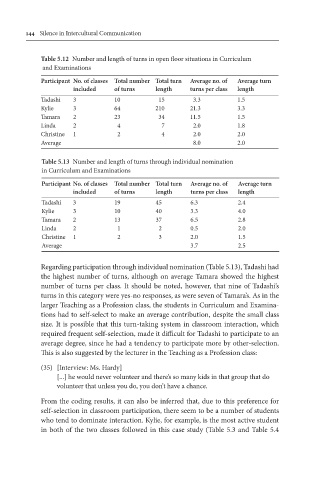
             Table 5.12  Number and length of turns in open floor situations in Curriculum
              and Examinations

             Participant No. of classes  Total number  Total turn   Average no. of   Average turn
                      included   of turns    length    turns per class  length
             Tadashi  3          10            15        3.3        1.5
             Kylie    3          64          210       21.3         3.3
             Tamara   2          23            34      11.5         1.5
             Linda    2            4             7       2.0        1.8
             Christine  1          2             4       2.0        2.0
             Average                                     8.0        2.0


             Table 5.13  Number and length of turns through individual nomination
             in Curriculum and Examinations

             Participant No. of classes  Total number  Total turn   Average no. of   Average turn
                      included   of turns    length    turns per class  length
             Tadashi  3          19          45        6.3          2.4
             Kylie    3          10          40        3.3          4.0
             Tamara   2          13          37        6.5          2.8
             Linda    2            1           2       0.5          2.0
             Christine  1          2           3       2.0          1.5
             Average                                   3.7          2.5

             Regarding participation through individual nomination (Table 5.13), Tadashi had
             the highest number of turns, although on average Tamara showed the highest
             number of turns per class. It should be noted, however, that nine of Tadashi’s
             turns in this category were yes-no responses, as were seven of Tamara’s. As in the
             larger Teaching as a Profession class, the students in Curriculum and Examina-
             tions had to self-select to make an average contribution, despite the small class
             size. It is possible that this turn-taking system in classroom interaction, which
             required frequent self-selection, made it difficult for Tadashi to participate to an
             average degree, since he had a tendency to participate more by other-selection.
             This is also suggested by the lecturer in the Teaching as a Profession class:
             (35)   [Interview: Ms. Hardy]
                     [...] he would never volunteer and there’s so many kids in that group that do
                     volunteer that unless you do, you don’t have a chance.
             From the coding results, it can also be inferred that, due to this preference for
             self-selection in classroom participation, there seem to be a number of students
             who tend to dominate interaction. Kylie, for example, is the most active student
             in both of the two classes followed in this case study (Table 5.3 and Table 5.4

