


Page 160 - Silence in Intercultural Communication
P. 160
Chapter 5.  Performance and perceptions of silence  147


             The coding results show that Miki actually volunteered her comments a few times,
             but Dr. Telfer was correct that Miki never asked a question except for confirma-
             tion questions in her Presentation Discussion.
                The above comment by the lecturer suggests that voluntary questioning and
             commenting is expected from students, and those who speak only when selected
             by others may be perceived as “unconfident” and “shy.” This perception can have
             particular consequences. In the excerpt below, Miki is supported by the lecturer
             in securing a turn:
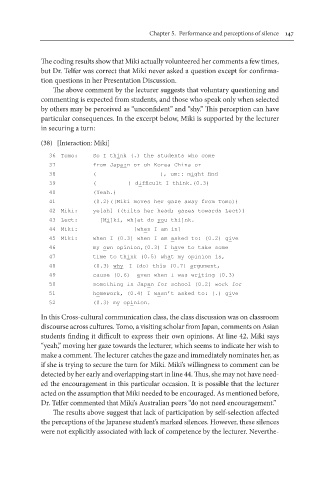
             (38)   [Interaction: Miki]

             	 	36		Tomo:				So	I	think	(.)	the	students	who	come
             	 	37										from	Japa:n	or	uh	Korea	China	or
             	 	38										(																	),	um::	might find
             	 	39										(									)	difficult I think.(0.3)
             	 	40										(Yeah.)
             	 	41										(0.2)((Miki	moves	her	gaze	away	from	Tomo))
             	 	42		Miki:				ye[ah]	((tilts	her	head;	gazes	towards	Lect))
             	 	43		Lect:									[Mi]ki,	wh[at	do	you	thi]nk.
             	 	44		Miki:															[when	I	am	in]
             	 	45		Miki:				when	I	(0.3)	when	I	am	asked	to:	(0.2)	give
             	 	46										my	own	opinion,(0.3)	I	have	to	take	some
             	 	47										time	to	think	(0.5)	what	my	opinion	is,
             	 	48										(0.3)	why		I	(do)	this	(0.7)	argument,
             	 	49										cause	(0.6)		even	when	I	was	writing	(0.3)
             	 	50										something	in	Japan	for	school	(0.2)	work	for
             	 	51										homework,	(0.4)	I	wasn’t	asked	to:	(.)	give
             	 	52										(0.3)	my	opinion.
             In this Cross-cultural communication class, the class discussion was on classroom
             discourse across cultures. Tomo, a visiting scholar from Japan, comments on Asian
             students finding it difficult to express their own opinions. At line 42, Miki says
             “yeah,” moving her gaze towards the lecturer, which seems to indicate her wish to
             make a comment. The lecturer catches the gaze and immediately nominates her, as
             if she is trying to secure the turn for Miki. Miki’s willingness to comment can be
             detected by her early and overlapping start in line 44. Thus, she may not have need-
             ed the encouragement in this particular occasion. It is possible that the lecturer
             acted on the assumption that Miki needed to be encouraged. As mentioned before,
             Dr. Telfer commented that Miki’s Australian peers “do not need encouragement.”
                The results above suggest that lack of participation by self-selection affected
             the perceptions of the Japanese student’s marked silences. However, these silences
             were not explicitly associated with lack of competence by the lecturer. Neverthe-

