


Page 162 - Silence in Intercultural Communication
P. 162
Chapter 5.  Performance and perceptions of silence  149


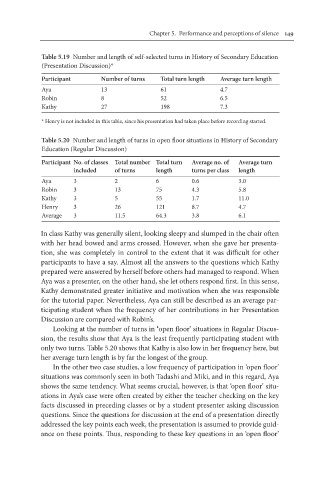
             Table 5.19  Number and length of self-selected turns in History of Secondary Education
             (Presentation Discussion)*
             Participant      Number of turns  Total turn length  Average turn length
             Aya              13               61              4.7
             Robin            8                52              6.5
             Kathy            27               198             7.3

             * Henry is not included in this table, since his presentation had taken place before recording started.

             Table 5.20  Number and length of turns in open floor situations in History of Secondary
             Education (Regular Discussion)
             Participant No. of classes  Total number  Total turn   Average no. of   Average turn
                      included    of turns   length    turns per class  length
             Aya      3           2          6         0.6           3.0
             Robin    3           13         75        4.3           5.8
             Kathy    3           5          55        1.7           11.0
             Henry    3           26         121       8.7           4.7
             Average  3           11.5       64.3      3.8           6.1

             In class Kathy was generally silent, looking sleepy and slumped in the chair often
             with her head bowed and arms crossed. However, when she gave her presenta-
             tion, she was completely in control to the extent that it was difficult for other
             participants to have a say. Almost all the answers to the questions which Kathy
             prepared were answered by herself before others had managed to respond. When
             Aya was a presenter, on the other hand, she let others respond first. In this sense,
             Kathy demonstrated greater initiative and motivation when she was responsible
             for the tutorial paper. Nevertheless, Aya can still be described as an average par-
             ticipating student when the frequency of her contributions in her Presentation
             Discussion are compared with Robin’s.
                Looking at the number of turns in ‘open floor’ situations in Regular Discus-
             sion, the results show that Aya is the least frequently participating student with
             only two turns. Table 5.20 shows that Kathy is also low in her frequency here, but
             her average turn length is by far the longest of the group.
                In the other two case studies, a low frequency of participation in ‘open floor’
             situations was commonly seen in both Tadashi and Miki, and in this regard, Aya
             shows the same tendency. What seems crucial, however, is that ‘open floor’ situ-
             ations in Aya’s case were often created by either the teacher checking on the key
             facts discussed in preceding classes or by a student presenter asking discussion
             questions. Since the questions for discussion at the end of a presentation directly
             addressed the key points each week, the presentation is assumed to provide guid-
             ance on these points. Thus, responding to these key questions in an ‘open floor’

