


Page 164 - Silence in Intercultural Communication
P. 164
Chapter 5.  Performance and perceptions of silence  151


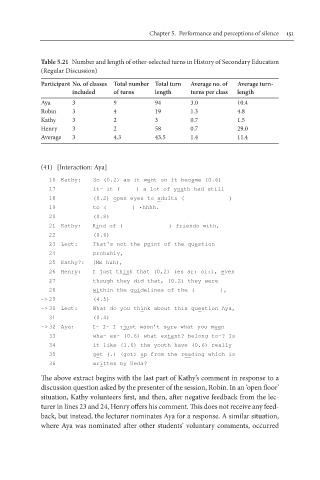
             Table 5.21  Number and length of other-selected turns in History of Secondary Education
             (Regular Discussion)
             Participant No. of classes  Total number  Total turn   Average no. of   Average turn-
                      included   of turns    length    turns per class  length
             Aya      3          9           94        3.0          10.4
             Robin    3          4           19        1.3          4.8
             Kathy    3          2           3         0.7          1.5
             Henry    3          2           58        0.7          29.0
             Average  3          4.3         43.5      1.4          11.4


             (41)   [Interaction: Aya]

             	 	16		Kathy:			So	(0.2)	as	it	went	on	it	became	(0.6)
             	 	17										it-	it	(					)	a	lot	of	youth	had	still
             	 	18										(0.2)	open	eyes	to	adults	(												)
             	 	19										to	(							)	•hhhh.
             	 	20										(0.8)
             	 	21		Kathy:			Kind	of	(												)	friends	with,
             	 	22										(0.6)
             	 	23		Lect:				That's	not	the	point	of	the	question
             	 	24										probably,
             	 	25		Kathy?:			(Mm	huh),
             	 	26		Henry:			I	just	think	that	(0,2)	(es	ar:	ci:),	even
             	 	27										though	they	did	that,	(0.2)	they	were
             	 	28										within	the	guidelines	of	the	(							),
             ->	29										(4.5)
             ->	 30		Lect:				What	do	you	think	about	this	question	Aya,
             	 	31										(0.4)
             -> 32  Aya:     I- I- I ↑just	wasn’t	sure	what	you	mean
             	 	33										wha-	ex-	(0.6)	what	extent?	belong	to-?	Is
             	 	34										it	like	(1.6)	the	youth	have	(0.6)	really
             	 	35										get	(.)	(got)	up	from	the	reading	which	is
             	 	36										written	by	Ueda?
             The above extract begins with the last part of Kathy’s comment in response to a
             discussion question asked by the presenter of the session, Robin. In an ‘open floor’
             situation, Kathy volunteers first, and then, after negative feedback from the lec-
             turer in lines 23 and 24, Henry offers his comment. This does not receive any feed-
             back, but instead, the lecturer nominates Aya for a response. A similar situation,
             where Aya was nominated after other students’ voluntary comments, occurred

