


Page 168 - Silence in Intercultural Communication
P. 168
Chapter 5.  Performance and perceptions of silence  155


             5.5.1  Silence as a strategy to maintain positive face of the self

             The Japanese students’ comments in the interviews suggested that silence is often
             used as a strategy to avoid loss of their own positive face (see Chapter 4, Section
             4.3.1). This strategy can generally be found in the low frequency of self-selected
             turns in the case studies, especially in the cases of Tadashi and Miki. The discus-
             sion in Chapter 4 showed that a lack of confidence in language proficiency as
             well as an awareness of inadequate background knowledge were found to inhibit
             voluntary participation. What is interesting is that none of the three Japanese stu-
             dents gave lack of confidence as a reason for their overall silence. Rather, they
             attributed their silence to inability: namely, lack of knowledge, understanding, or
             interactional skills. The ‘inability’ explanations are valid in a number of ways, as
             we have seen in the struggle with turn-taking above, and, as we will see later in
             Section 5.6.2, there are topics which place Japanese students at a disadvantage due
             to limited experience in, and limited cultural knowledge of, Australia. However,
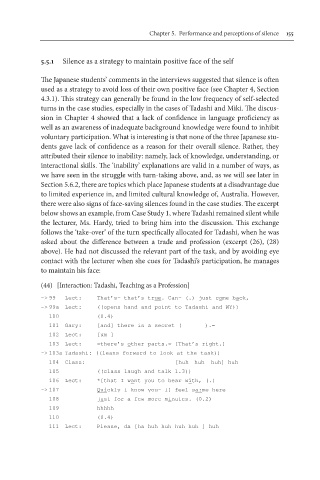
             there were also signs of face-saving silences found in the case studies. The excerpt
             below shows an example, from Case Study 1, where Tadashi remained silent while
             the lecturer, Ms. Hardy, tried to bring him into the discussion. This exchange
             follows the ‘take-over’ of the turn specifically allocated for Tadashi, when he was
             asked about the difference between a trade and profession (excerpt (26), (28)
             above). He had not discussed the relevant part of the task, and by avoiding eye
             contact with the lecturer when she cues for Tadashi’s participation, he manages
             to maintain his face:

             (44)   [Interaction: Tadashi, Teaching as a Profession]
             ->	99			Lect:				That’s-	that’s	true.	Can-	(.)	just	come	back,
             ->	99a		Lect:				((opens	hand	and	point	to	Tadashi	and	WY))
             	 	100										(0.4)
             	 	101		Gary:				[and]	there	is	a	secret	(						).=
             	 	102		Lect:				[um	]
             	 	103		Lect:				=there’s	other	parts.=	[That’s	right.]
             ->	103a	Tadashi:	((leans	forward	to	look	at	the	task))
             	 	104		Class:																									[huh				huh					huh]	huh
             	 	105										((class	laugh	and	talk	1.3))
             	 	106		Lect:				*[that	I	want	you	to	bear	with,	(.)
             ->	107										Quickly	I	know	you-	I]	feel	sa:me	here
             	 	108										just	for	a	few	more	minutes.	(0.2)
             	 	109										hhhhh
             	 	110										(0.4)
             	 	111		Lect:				Please,	da	[ha	huh	huh	huh	huh	]	huh

