


Page 170 - Silence in Intercultural Communication
P. 170
Chapter 5.  Performance and perceptions of silence  157


             who “lets it pour out regardless how grammatical it is.” This student, Nakki, was
             perceived by the lecturer as an excellent student, although she was aware that this
             student did not always attend the class.
                As we have seen, the perceived silence of the Japanese students had a nega-
             tive effect on perceptions of academic competence, yet the desire to avoid being
             perceived as an incompetent student seems to have led to the face-saving silence
             of the Japanese students. Thus, when studying in the Australian education system,
             academic achievement seems to be sacrificed to some degree by Japanese students
             for the sake of saving face.


             5.5.2  Silence to save the other’s face: “Don’t do the FTA” strategy

             Silence is also used as a “Don’t do the FTA” strategy in a classic sense (see Brown
             & Levinson 1987; Sifianou 1997) when Japanese students refrain from expressing
             disagreement with the lecturer (see Chapter 4, 4.3.2) This use of silence, in place
             of the verbal expression of critical views or disagreement, can be identified as the
             superstrategy of “Don’t do the FTA,” and this was also found among the Japanese
             students in the case studies. They rarely made critical comments or disagreed with
             anyone, while their Australian peers showed more willingness to verbally demon-
             strate their critical thinking, which is valued in Australian university education
             (Ballard 1996; Ballard & Clanchy 1991; Matsuda 2000; Milner & Quilty 1996).
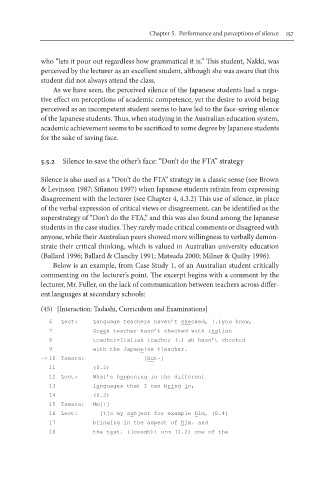
                Below is an example, from Case Study 1, of an Australian student critically
             commenting on the lecturer’s point. The excerpt begins with a comment by the
             lecturer, Mr. Fuller, on the lack of communication between teachers across differ-
             ent languages at secondary schools:

             (45)   [Interaction: Tadashi, Curriculum and Examinations]

             	 	6			Lect:				Language	teachers	haven’t	checked,	(.)you	know,
             	 	7											Greek	teacher	hasn’t	checked	with	Italian
             	 	8											teacher=Italian	teacher	(.)	ah	hasn’t	checked
             	 	9											with	the	Japane[se	t]eacher.
             ->	10		Tamara:																			[But-]
             	 	11										(0.2)
             	 	12		Lect:				What’s	happening	in	the	different
             	 	13										languages	that	I	can	bring	in,
             	 	14										(0.2)
             	 	15		Tamara:			Mm[:]
             	 	16		Lect:									[t]o	my	subject	for	example	film,	(0.4)
             	 	17										bringing	in	the	aspect	of	film.	and
             	 	18										the	text.	((cough))	u:m	(1.2)	one	of	the

