


Page 171 - Silence in Intercultural Communication
P. 171
158  Silence in Intercultural Communication


             	 	19											successes	with	French	and	German,	(0.2)	and
             	 	20											then	later	Japane:se,	was	(.)	precisely
                21           using film. (0.5) and it’s come late	to	some
             	 	22											other	languages	=	you	were	gonna	say
             	 	23											but	(.)	I'm	sorry,=
             ->	24		Tamara:				=Ahm		yeah	I-	I	understand	like	cause	I’ve
             	 	25											been	studying	Greek	for	many	many	many	many
             	 	26											years	since	(.)	you	know	kindergarten,	and
             	 	27											uni,(0.7)	but-	um	(0.4)	uh	I	just	don’t
             	 	28											know	okay	we	have	to	implement	new
             	 	29											strategies	in	order	to	get	(0.2)	you	know,
             	 	30											candidates	to	continue	the	language,	·hhh
             	 	31											but	I	think	it’s	(0.4)	it-	it	varies	from
             	 	32											>subject	to	subject<	cause	once	you	get	to
             	 	33											>year	eleven	and	twelve	for	Greek<	it’s	more
             	 	34											content	based.	·hh	I	don’t	know	how	>you
             	 	35											will	be	able	to<	introduce	it.=
             	 	36		Lect:					=(Right/But),
             ->	37		Tamara:				and	I	don’t	know	how	students	would
             	 	38											react.	(0.4)	I	don’t	know	if	it’s	such	a
             	 	39											difference?
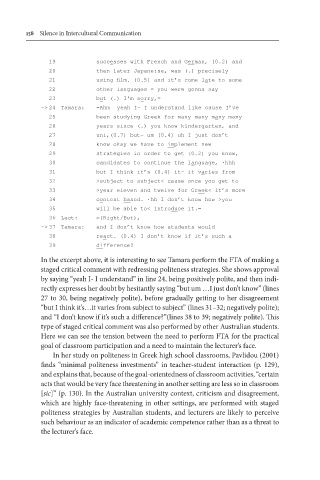
             In the excerpt above, it is interesting to see Tamara perform the FTA of making a
             staged critical comment with redressing politeness strategies. She shows approval
             by saying “yeah I- I understand” in line 24, being positively polite, and then indi-
             rectly expresses her doubt by hesitantly saying “but um …I just don’t know” (lines
             27 to 30, being negatively polite), before gradually getting to her disagreement
             “but I think it’s…it varies from subject to subject” (lines 31–32; negatively polite);
             and “I don’t know if it’s such a difference?”(lines 38 to 39; negatively polite). This
             type of staged critical comment was also performed by other Australian students.
             Here we can see the tension between the need to perform FTA for the practical
             goal of classroom participation and a need to maintain the lecturer’s face.
                In her study on politeness in Greek high school classrooms, Pavlidou (2001)
             finds “minimal politeness investments” in teacher-student interaction (p. 129),
             and explains that, because of the goal-orientedness of classroom activities, “certain
             acts that would be very face threatening in another setting are less so in classroom
             [sic]” (p. 130). In the Australian university context, criticism and disagreement,
             which are highly face-threatening in other settings, are performed with staged
             politeness strategies by Australian students, and lecturers are likely to perceive
             such behaviour as an indicator of academic competence rather than as a threat to
             the lecturer’s face.

