


Page 169 - Silence in Intercultural Communication
P. 169
156  Silence in Intercultural Communication


             	 	112			Class:														[huh	huh	huh	huh	huh]
             	 	113			Kylie:			You	can’t	ma[ke	us,]
             	 	114			Lect:															[·hhuh	]	huh,
             	 	115			Class:			Uh	huh	huh	huh	huh	huh=
             	 	116			?:							=We	have	right				[(							]	)
             	 	117			Lect:																			[Quickly,]	]
             ->	117a		Lect:																			[((pointing	at	Tadashi	and	WY))
             ->	117b		Tadashi:																	[((Tadashi	is	looking	down))
             	 	118											(1.0)	((students	mumbling	jokes))
             	 	119			?:							[We	k]now	our	rights.
             	 	120			Lect:				[U:m	]
             ->	121											(0.6)((Tadashi	looks	up	and	sits	straight))
             	 	122			Lect:				u:m	[(0.3)	way	you	dress	speak	behave,
             ->	122a		Tadashi:							[((looks	down))
             	 	123											dress:,(0.2)	all	right?	[(0.4)	How
             ->	123a		Tadashi:																								[((looks	up	at	Lect))
             	 	124			Lect:				dress[ing	,]
                125   Kylie:        [firs-]
             ->	126			Lect:				all	of	[you?
                127   Kylie:         [first	week	suits:.]
             	 	128											(0.4)
             	 	129			Lect:				That’s	right.
                                                            *[]  overlaps the laughter
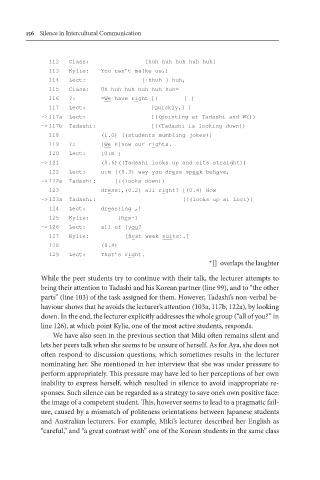
             While the peer students try to continue with their talk, the lecturer attempts to
             bring their attention to Tadashi and his Korean partner (line 99), and to “the other
             parts” (line 103) of the task assigned for them. However, Tadashi’s non-verbal be-
             haviour shows that he avoids the lecturer’s attention (103a, 117b, 122a), by looking
             down. In the end, the lecturer explicitly addresses the whole group (“all of you?” in
             line 126), at which point Kylie, one of the most active students, responds.
                We have also seen in the previous section that Miki often remains silent and
             lets her peers talk when she seems to be unsure of herself. As for Aya, she does not
             often respond to discussion questions, which sometimes results in the lecturer
             nominating her. She mentioned in her interview that she was under pressure to
             perform appropriately. This pressure may have led to her perceptions of her own
             inability to express herself, which resulted in silence to avoid inappropriate re-
             sponses. Such silence can be regarded as a strategy to save one’s own positive face:
             the image of a competent student. This, however seems to lead to a pragmatic fail-
             ure, caused by a mismatch of politeness orientations between Japanese students
             and Australian lecturers. For example, Miki’s lecturer described her English as
             “careful,” and “a great contrast with” one of the Korean students in the same class

